

Construction Estimator Salary UK in 2026: Must-Read Guide
Before a single brick gets laid, someone has to work out what the job will actually cost, and that’s the estimator’s job. They read the drawings and specifications, pull together take-offs, chase supplier and subcontractor quotes, and build the cost case behind the tender.
If the bid is won, the project moves to a quantity surveyor and a site team. If it’s lost, the estimator moves on to the next one.
So what I found was, it’s one of the more flexible ways into construction’s commercial side. Pay ranges from around £22,000 for an assistant estimator up to £120,000 or more for a Chief Estimator running the bid function at a Tier 1 contractor.
When it comes to a single range, blend the major job boards, and a realistic national average sits between £42,000 and £50,000.
Welcome to BuildCareerUK. This guide is for anyone weighing up estimating as a career, working estimators due for a pay review or a job move, and employers trying to work out what a fair offer looks like. Instead of leaning on one average, it walks through how experience, location, sector and the company you work for all pull that number in different directions.
What UK estimators actually earn
| Level | Experience | UK Average Salary | London Average |
| Entry-level (Assistant / Junior Estimator) | 0–2 years | £22,000 – £40,000 | £28,000 – £45,000 |
| Mid-level (Estimator) | 2–6 years | £38,000 – £60,000 | £45,000 – £65,000 |
| Senior-level (Senior Estimator / Estimating Manager) | 6+ years | £55,000 – £85,000+ | £65,000 – £95,000+ |
| National average (all levels) | — | ~£42,000 – £50,000 | ~£50,000 – £58,000 |
Go looking for a single “average estimator salary” online and you’ll get a different answer depending on where you look. This role has more disagreement between sources than almost any other in this series. PayScale says £32,229. Glassdoor says £36,802. Indeed says £48,611. SalaryExpert puts it higher still, at £52,974. The lower two numbers come from small, self-reported samples that lean junior. The higher two lean on employer data and larger, more experienced samples. £42,000–£50,000 is a fair, honest baseline. Treat it as a starting point, not the final word.
How does your pay actually build?
Experience matters, but it’s not really years on the calendar that move the number. It’s what you’ve been trusted to price on your own. An assistant estimator typically starts between £22,000 and £32,000 (UK Trade Jobs), rising to £28,000–£45,000 at larger contractors with proper graduate schemes (Construction Job Board).
Once you can price a full bid package by yourself, pay climbs into the £38,000–£60,000 range. Lead major bids or a small estimating team, and £55,000–£85,000 becomes realistic; SalaryExpert puts eight-plus years’ experience at around £59,764.
At the top, Chief Estimators and Heads of Estimating at Tier 1 contractors can earn £90,000 to £120,000 or more, including bonus.
Estimating differs from quantity surveying or civil engineering in one clear way, as there’s no single mandatory qualification staircase to climb. Most estimators have a degree or HNC/HND in quantity surveying, construction management or civil engineering (CV-Library).
Where you work, and who for, changes things too

If you have ideas on getting the best salary you can, then there are some important things to consider. That is because, as I mentioned, where you work, who for, affects your salary too.
Where you plan to work?
| Region | Typical Salary | Why |
| London & South East | £48,000 – £70,000+ | Major contractors, high-value commercial and residential bids |
| North West (Manchester, Liverpool) | £38,000 – £54,000 | Housing, infrastructure tender volume |
| Midlands (Birmingham, Coventry) | £36,000 – £52,000 | HS2, housebuilding, M&E demand |
| Scotland (Glasgow, Edinburgh, Aberdeen) | £36,000 – £52,000 | Transport and energy tenders |
| Yorkshire & North East | £34,000 – £48,000 | Water investment, rail |
| Wales & South West | £33,000 – £46,000 | Hinkley Point C, steady housebuilding |
As always, London’s premium is real. Indeed’s London figure of £55,339 runs about 14% above its own national average, a smaller gap than you’ll see for quantity surveyors or civil engineers. A lot of strong estimating demand sits with regional Tier 1 offices and specialist subcontractors well outside London too.
To whom?
The company you work for shapes pay just as much as where you sit. Tier 1 main contractors, names like Balfour Beatty, Kier, BAM, Skanska and Laing O’Rourke, run the largest in-house bid teams and offer the clearest route to Chief Estimator.
Specialist and M&E subcontractors are worth a look too as pricing mechanical, electrical, façade or groundworks packages pays well, often matching main-contractor rates at the same seniority (Construction Job Board).
Freelance or interim work usually pays £280 to £500 a day, with infrastructure and specialist packages at the top of that range. But you give up holiday pay and sick pay, and your workload rises and falls with the tender calendar.
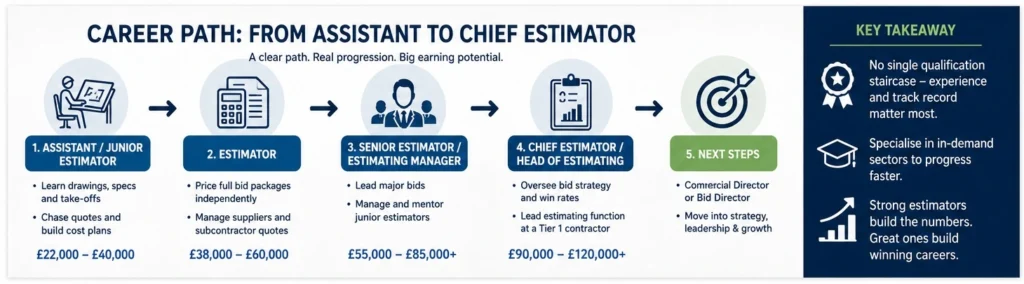
Career path – From assistant to chief estimator
Most estimating careers follow a similar path. You start as a,
- graduate or junior estimator learning to read drawings and chase quotes, and
- move into a full estimator role once you can price a package unsupervised, then
- step up to senior estimator or estimating manager once you’re leading bids and mentoring juniors.
From there, the ceiling is Chief Estimator or Head of Estimating at a Tier 1 contractor, or a move into Commercial Director or Bid Director once the role becomes more about strategy than pricing detail.
It’s also a common launch pad for a sideways move. Plenty of estimators end up in quantity surveying, project management or business development rather than staying on a single ladder (Construction Job Board). If you want to speed up your own progression, building a track record in one specific, in-demand specialism tends to open doors faster than staying a generalist.
FAQs.
Yes. It’s one of the more flexible ways into construction’s commercial side, it doesn’t lock you into one qualification route, and it has a genuine ceiling: Chief Estimators at Tier 1 contractors can earn £90,000–£120,000+.
A degree or HNC/HND in quantity surveying, construction management or civil engineering is the most common route in, but plenty of estimators arrive via trades or site experience and build CIOB’s or RICS’s estimating-related credentials alongside the job.
No, and that’s fairly unusual for construction. MCIOB or MRICS helps, particularly if you’re aiming for Chief Estimator or Commercial Director, but track record and sector specialism carry just as much weight.
The bottom line
Estimator pay in the UK runs from around £22,000 to £120,000+. The gap between those two numbers comes down to what you can price and where you’ve proven it, more than any fixed qualification path. Early on, focus on building a visible track record across real bids rather than chasing a certificate for its own sake.
Once you’re established, specialising and staying open to moving between main contractor, subcontractor and consultancy work are the two clearest ways to keep climbing. Whatever number you’re on now, check it against your specific sector and region before your next pay conversation, not against a single average pulled from one website.