SMSTS vs SSSTS: Which One Do You Actually Need in 2026?
I’ve spent the past few weeks doing something really important for construction workers: figuring out the real difference between SMSTS and SSSTS. And I’ve worked out why so many people get this wrong.
The two courses look identical from the outside. Same provider, same website, same “add to basket” button. One is two days, and one is five. That’s the only difference most people notice before they pay.
Then they get on site and find out they’ve booked the wrong one.
So here’s everything I found, laid out properly. What each course is, what it costs in 2026, and the one question that tells you which one to book.
What These Two Courses Actually Are?
Simply,
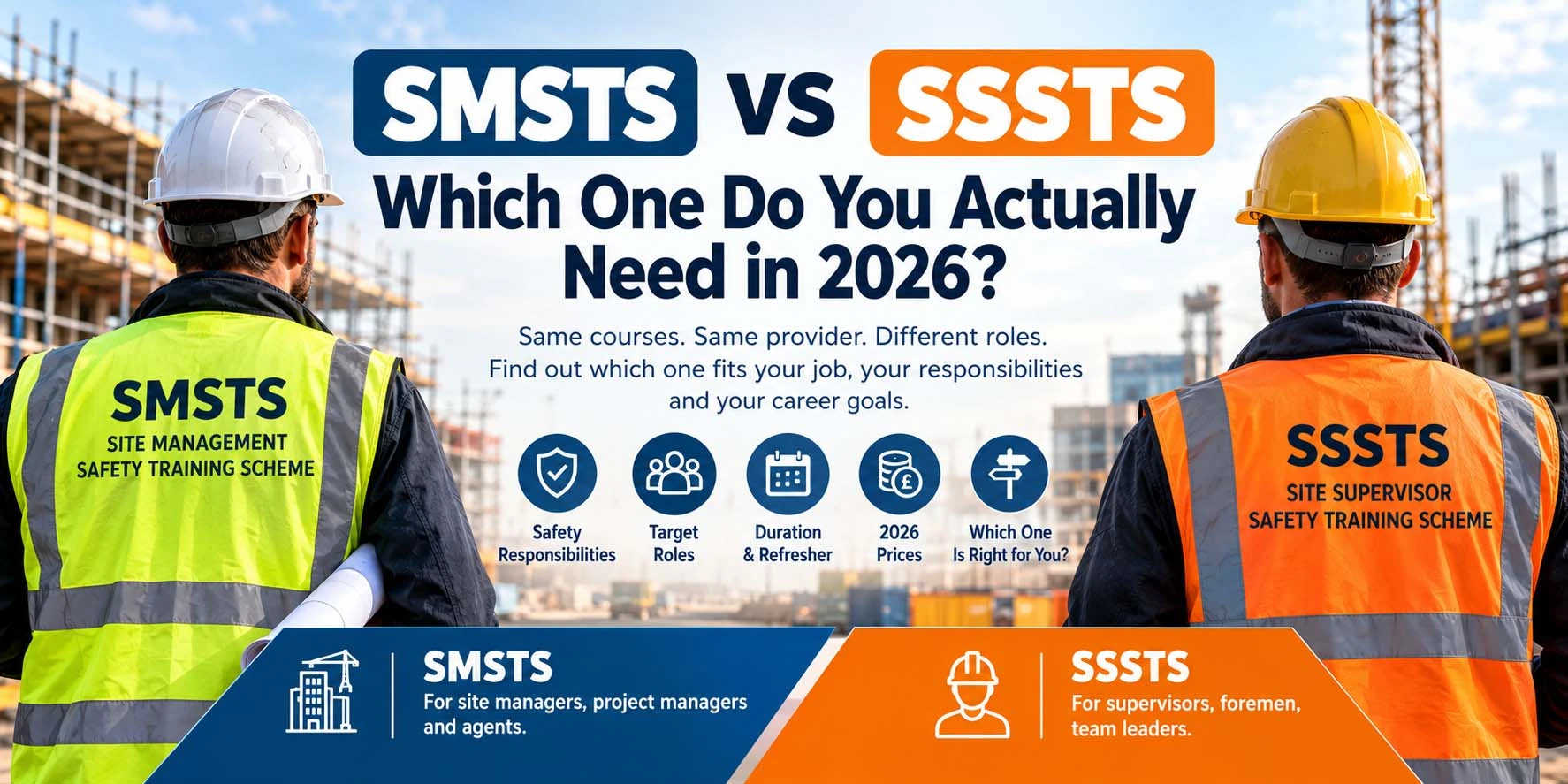
SSSTS is the Site Supervisor Safety Training Scheme. Two days.
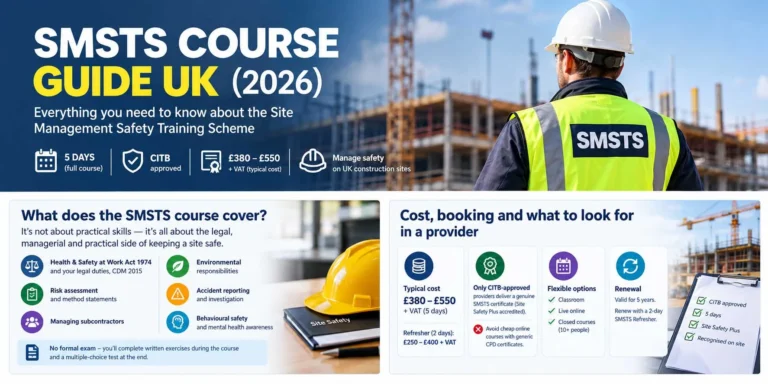
SMSTS is the Site Management Safety Training Scheme. Five days.
Both sit inside the CITB Site Safety Plus programme, both are recognised UK-wide, and neither is a legal requirement on paper, which surprises people. But when you try to get a supervisor or manager role on a major site without one is basically somewhat harder in the UK now.
The Real Difference: What You’re Responsible For
I kept hearing the same thing from providers: the course isn’t about your job title, and it’s about what you’re accountable for.
SSSTS is aimed at first-line supervisors, such as foremen, chargehands and team leaders. You’re usually out on site with the lads, keeping an eye on the work and making sure it’s being done safely. You’ll run inductions and toolbox talks, check PPE, sort out issues as they come up, and flag bigger problems to the site management team.
SMSTS is aimed at site managers, project managers and agents. You’re looking at the bigger picture, planning the work, managing risks and making sure the site is meeting its legal and CDM requirements.
You’re responsible for making sure the paperwork matches what’s actually happening on site. If the HSE turns up and starts asking questions, you’ll usually be one of the people dealing with them.
To simply find out what you need – when something goes badly wrong, whose name is on the incident report? If it’s yours, you need SMSTS. If you’re the one reporting it to that person, SSSTS is your course.
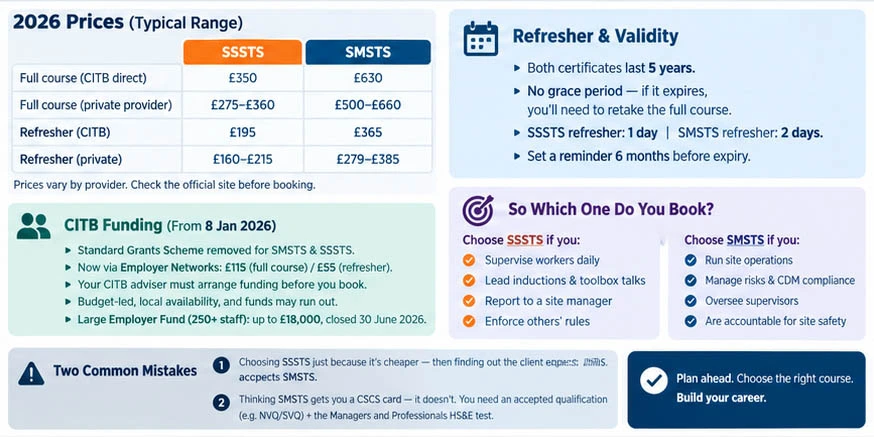
Side-by-Side, With Real 2026 Prices
| Feature | SSSTS | SMSTS |
| Target role | Supervisors, foremen, team leaders | Site managers, project managers, agents |
| Duration | 2 days | 5 days |
| Refresher | 1 day | 2 days |
| Validity | 5 years | 5 years |
| CITB direct price | £350 | £630 |
| Private provider | £275–£360 | £500–£660 |
| Refresher (CITB) | £195 | £365 |
| Refresher (private) | £160–£215 | £279–£385 |
| CITB test needed? | No | No |
| Build UK endorsed | Yes | Yes |
Those prices are what I actually found quoted, not guesses. And the gap between cheap and expensive providers is bigger than you’d think. Nearly £400 difference on the SMSTS depending on where you book.
But it is important to check their official site before booking, as the prices may vary from time to time.
What You Actually Learn?
SSSTS
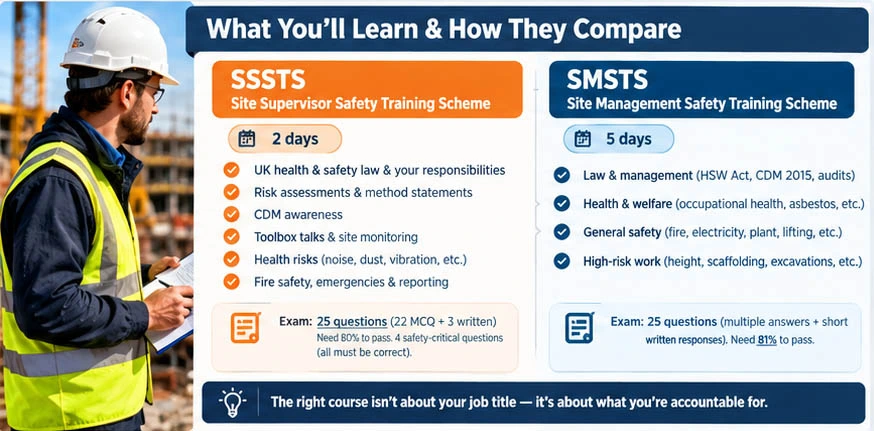
The SSSTS course runs for two full days and covers the main health and safety responsibilities you need as a site supervisor.
You’ll learn about UK health and safety law and your responsibilities on site. You’ll also learn how to read risk assessments and method statements, and more importantly, how to check that the actual work matches what’s written down.
The course also covers the basics of CDM, how to run toolbox talks that workers actually pay attention to, occupational health risks such as noise, dust, vibration, and manual handling, plus fire safety, emergencies, site monitoring, and reporting.
At the end, there’s a 25-question exam. This includes 22 multiple-choice questions and 3 written questions. You need 80% to pass.
There are also four safety-critical questions. You must get all four right, even if you score 80% overall. Get one of these wrong, and you fail the exam.
SMSTS
SMSTS is tougher: five days, four modules.
Law and management covers the Health and Safety at Work Act, detailed CDM 2015 rules, safety systems, audits, and accident investigations.
Health and welfare covers occupational health, welfare facilities, stress, mental health, drugs and alcohol, asbestos, lead, and hazardous substances.
General safety covers site setup, fire, electricity, temporary works, plant, and lifting operations.
High-risk work covers working at height, scaffolding, fall arrest, excavations, underground services, and confined spaces.
The exam has 25 questions, but you need 81% to pass. It includes questions with several correct answers and short written responses. It tests understanding.
The Refresher Trap Nobody Warns You About
Both certificates last five years. That’s the easy part.
The tricky part is that there’s no grace period. Not a week. Not a day. If your certificate expires on Friday and your refresher is booked for the next Monday, you’ve missed the deadline. You’ll have to take the full course again.
I checked with three providers because I thought there might be some flexibility. There isn’t. The CITB rules are clear.
The SSSTS refresher takes one day. The SMSTS refresher takes two days. Both take less time and cost less than starting again, so mark the date. Set a calendar reminder six months before it expires. It sounds obvious until you’re explaining to a principal contractor that your card expired three weeks ago.
What It Costs and the CITB Change That Caught People Out
Here’s where it gets frustrating.
On 8 January 2026, CITB removed standard Grants Scheme funding for SMSTS and SSSTS. That automatic route closed.
Eligible courses now get funding through CITB Employer Networks. Their published table lists £115 per full course and £55 per refresher. These are fixed contributions, not course prices.
Before then, grants paid up to £240 for SMSTS and £120 for SSSTS. That’s a steep cut for SMSTS, but only a slight cut for SSSTS.
There’s a booking catch: your CITB adviser must arrange funding through the Employer Network Booking Team before you book. You can’t book yourself and claim later.
Funding is budget-led and depends on local availability, so amounts can change and money may run out during the year.
From 1 April 2026, employers with 250 or more staff lost access to Employer Networks. CITB launched a Large Employer Fund for 2026–27, offering up to £18,000, but its funding window closed 30 June. If you’re at a large firm, check your options with CITB; don’t assume your old arrangement still applies.
So Which One Do You Book?
Ask one question, and be honest with yourself.
Choose SSSTS if you supervise workers each day, lead inductions and toolbox talks, report to a site manager, and enforce rules set by someone else.
Choose SMSTS if you run site operations, write risk assessments, manage CDM compliance and supervisors, and are accountable for site safety performance.
If you’re unsure and have limited health and safety management experience, start with SSSTS. It gives you a foundation. You can move up to SMSTS later when your job title changes.
I spoke to one provider who said roughly half the people who book SSSTS come back for SMSTS within three years. That tracks. It’s a career ladder, not a fork in the road.
Two Mistakes I See Often
The first is choosing SSSTS because it costs less, then finding out the client expects SMSTS. You could end up paying for another course. Check the job description and client’s requirements before booking.
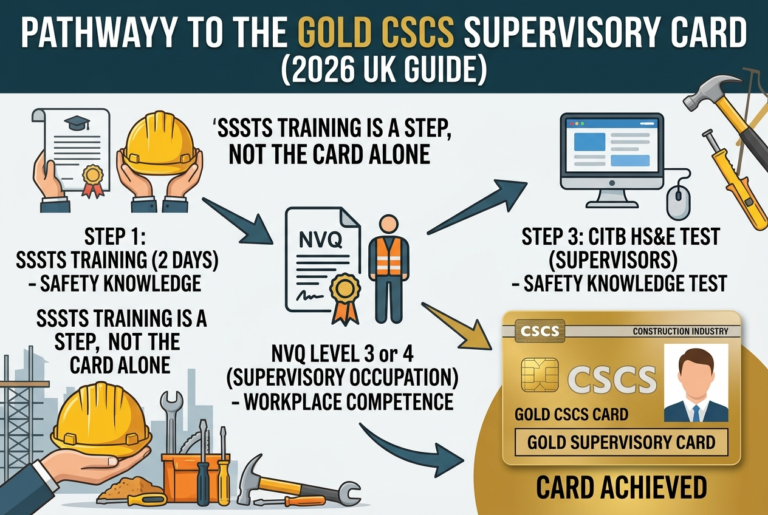
The second is thinking SMSTS gets you a CSCS card. It doesn’t. SMSTS is safety training, and CSCS does not accept it as a card qualification. For a Black Manager Card, you need an accepted construction management or technical qualification, such as the relevant NVQ/SVQ, and the Managers and Professionals HS&E test. Check CSCS’s Black Manager Card guidance and apply for the card separately.
Final Thoughts
SSSTS suits day-to-day supervision. SMSTS focuses on managing site operations and safety. Choose based on your responsibilities and the client’s requirements, not price alone.
Both certificates last five years. Complete the refresher before expiry; if your certificate expires first, CITB says you’ll need to retake the full course. See the SSSTS and SMSTS guidance.
Save the expiry date in your phone as soon as the certificate arrives. Five years goes by quickly.