
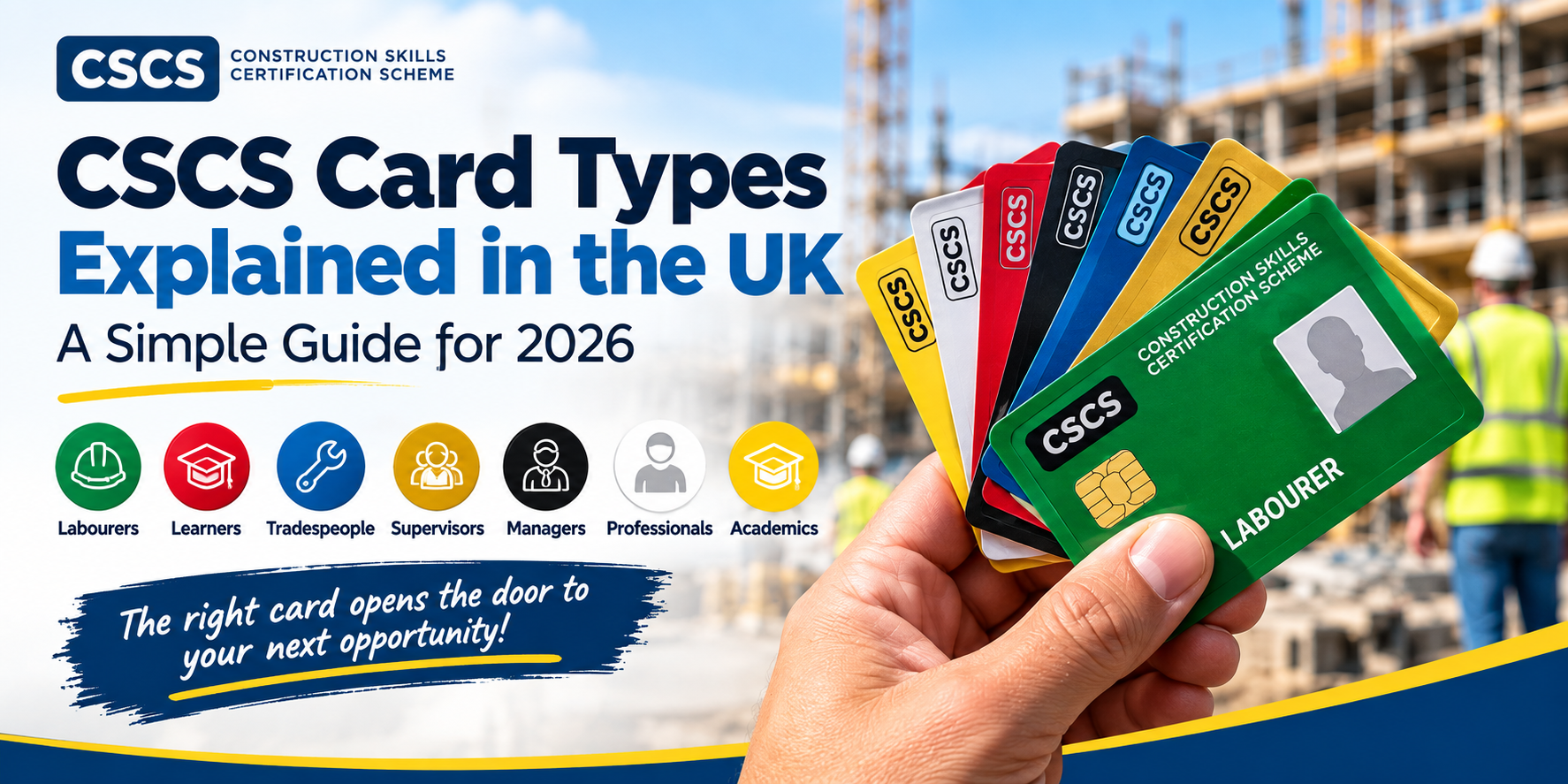
CSCS Card Types Explained in the UK: A SimpleGuide for 2026
This starts when you want to work on a construction site, someone tells you to get a CSCS card, you look it up, and about fifteen different colours stare back at you. Green, red, blue, gold, black, white, yellow. Feels like you need a degree in colour theory just to get through the gate.
Relax. It’s not that bad. Over two million CSCS cards are in circulation in the UK right now, and they all fit into a pretty simple system once someone explains it properly.
So int his guide, I will explain what those cards mean, and how to use them for your career growth in the UK construction field.
What Is a CSCS Card?
CSCS stands for Construction Skills Certification Scheme. The card tells a site manager that you’ve got the right training and know how to keep yourself and others safe on site.
Here’s something people don’t always realise; CSCS cards aren’t a legal requirement. You won’t get fined for not having one. But when you are trying to get onto any decent-sized site without a CSCS card, sometimes you may not get selected, and most contractors won’t touch you. So, no card, no work, end of story.
There are different colors of the card, and the colour matters because it tells the site manager what you’re qualified to do. Glance, and they know it.
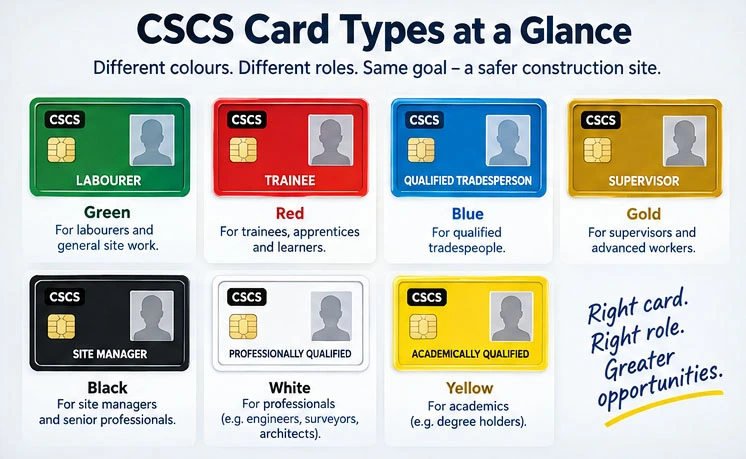
What are types of CSCS cards?
As I’ve mentioned there are a lot of cards, let’s break it down one by one, to get a clear understanding on each, to find out what card the the best match for you.
The Green Card: For Labourers
Green is where most people start. It’s for labourers, general site work, and for those kinds of similar things.
What does that actually mean day-to-day? Groundwork, demolition, clearing up, helping out the trades. You’re the extra pair of hands. Nothing glamorous, but it gets you on site and earning.
You don’t need a trade qualification for this one. Just pass the CITB Health, Safety and Environment test and hold a Level 1 Health and Safety Awareness qualification. That’s the whole list.
The card lasts two years the first time, then five when you renew. Importantly, when you renew, CSCS might ask to see an NVQ or some assessed qualification. So if you’re thinking of sticking around in construction, don’t leave it too late to sort that out.
The Red Cards: Temporary Cards for People Still Learning
Red cards are temporary. They’re for trainees, apprentices, and anyone working towards a qualification. There are several types, so let’s find out what they are.
Apprentice card. For anyone on a recognised construction apprenticeship. Free of charge, which is always nice.
Trainee card. Less than a year of experience and signed up for a construction qualification? This is yours.
Provisional card. For new starters on probation. Lasts six months and you don’t need the CITB test. Handy if you’re just getting started.
Industry Placement card. For students doing a qualification that needs a work placement. The good news here is CSCS dropped the minimum placement from 30 days to three weeks recently. Made things a lot easier for students trying to get site experience.
Experienced Worker card. Been doing the job for years but never got the paperwork? You need to be registered for an NVQ or SVQ to get this one.
Experienced Technical, Supervisor or Manager card. Same idea, but for people in supervisory or management roles.
Reminder – All red cards except the Provisional require a valid CITB test pass.
The Blue Card: For Qualified Tradespeople
Blue is the most common card in the field, and if you’ve got an NVQ or SVQ Level 2 in your trade, this is the one for you.
If you are a bricklayer, electrician, carpenter, or plant operator, basically, if you’re hands-on and you’ve got the qualification to prove it, you’re blue.
The process is simple. Show your Level 2, pass the CITB Health, Safety and Environment test, and you’re done; the card is valid for five years and renews without any hassle.
The Gold Card: Supervisors and Advanced Workers
Gold does two different jobs, which confuses people sometimes.
First, it’s for advanced skilled workers who’ve got an NVQ or SVQ Level 3 in their trade. So, you know the type – been on the tools for years, knows their stuff inside out, and has the certificate to back it up.
Second, and more commonly, it’s for supervisors, like foremen, chargehands, team leaders. If you’re running a small crew, this is the card you need, and you’ll need an NVQ Level 3 or 4 in a supervisory or technical qualification.
One important thing: for the supervisory gold card, you have to pass the Supervisors level CITB test, not the standard Operatives one. People get caught out by this all the time. Don’t be one of them.
The Black Card: For Site Managers
Black is the top card for site-based roles. We’re talking site managers, senior construction professionals, that level.
You’ll usually need an NVQ Level 4, 5, 6, or 7 in construction management, or a relevant degree, and additionally, you’ll need to pass the Managers and Professionals CITB test.
A lot of black card holders also have SMSTS. These are the people running the show – safety, planning, making sure the job actually gets finished. It’s a big responsibility, and the card reflects that.
White and Yellow Cards: For Professionals and Academics
Not everyone on site is there to do hard work with hammers, and machinery. Some people design, plan, and oversee.
The white card is for Professionally Qualified Persons, like engineers, surveyors, and architects, who are full members of recognised institutions like CIOB, ICE, or RICS.
The yellow card is for Academically Qualified Persons. That means construction-related degrees, HNDs, HNCs, CIOB Certificates, NEBOSH diplomas.
These cards recognise that some people bring value through knowledge rather than trade skills.
Recent Changes Worth Knowing
The scheme changes from time to time, so here’s what’s new.
From 1 October 2026, things are shifting in utilities. EUSR SHEA registrations won’t automatically get printed onto a CSCS Green Labourer card anymore. Labourers in utilities need to apply for a new EUSR CSCS Green Utilities Labourer card. Everyone else needs the CSCS card that matches their actual role.
Also, back in July 2026, the Industry Placement card rules got relaxed. Minimum work placement dropped from 30 days to three weeks. Card validity changed from three years to two years. This lines up with Department for Education guidance for level 2 and 3 construction qualifications.
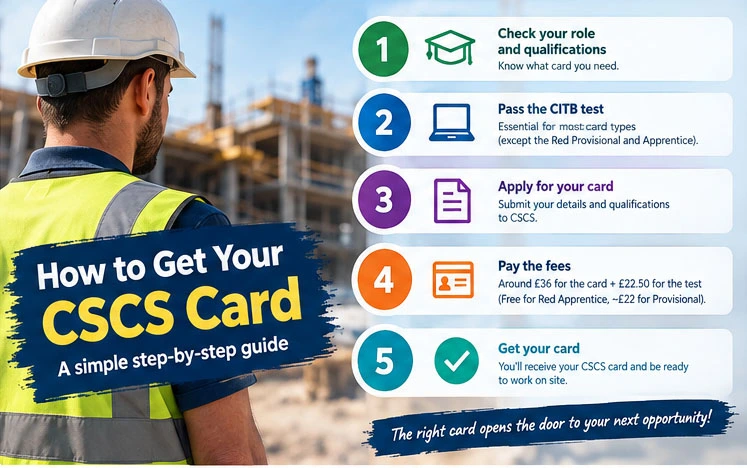
How to Choose the Right Card?
Honestly, just ask yourself two questions.
What’s my job role? Labourer, tradesperson, supervisor, manager?
What qualifications do I actually hold? NVQ? What level? Working towards one?
Still stuck? The official CSCS website has a Card Finder tool. Use it.
On cost, most cards are around £36, plus £22.50 for the CITB test. The Red Apprentice card is free, and the Red Provisional is about £22.
Final Thoughts
Picking the right CSCS card isn’t complicated once you understand the colours. Green for labourers. Red for learners. Blue for qualified trades. Gold for supervisors and advanced workers. Black for managers. White and yellow for professionals and academics.
If you’re brand new, green gets you on site fastest. As you gain qualifications, you move up. Blue, then gold, maybe black one day. Coming from a professional or academic background? White or yellow will be your fit.
Whichever card you need, the recipe is the same. Pass the CITB Health, Safety and Environment test. Hold the qualification that matches your role. Sort those two things, and you’ll get the card and your career moving forward.