
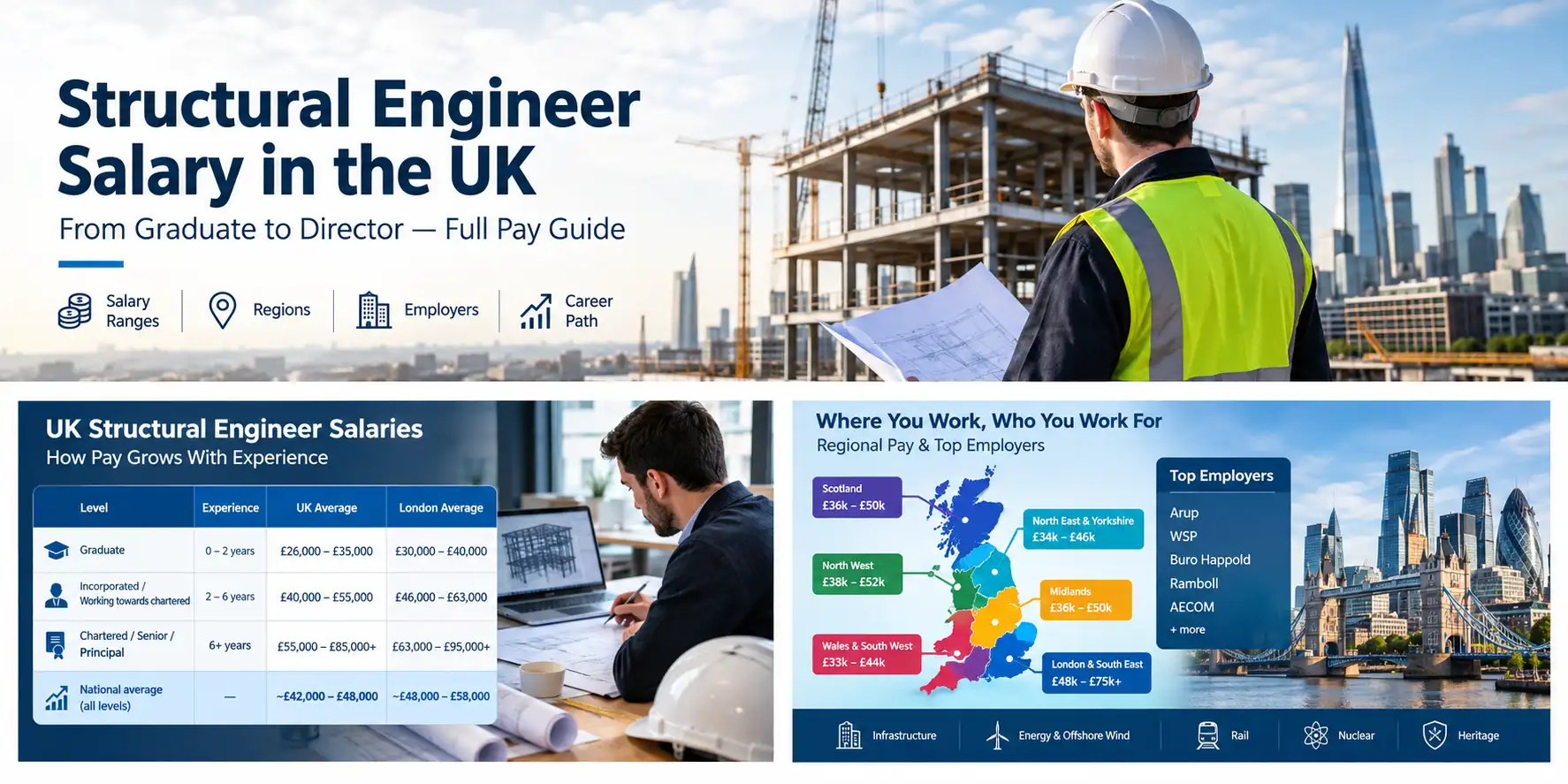
Structural Engineer Salary in the UK; Must Read
A structural engineer works out how a building or bridge actually stands up. They calculate the loads a structure needs to carry, from gravity and wind to the weight of the building itself, and design the frame, foundations and connections that make it safe. Most work comes from an architect’s concept design, using both hand calculations and structural software, and most of the job sits inside a design consultancy rather than on a building site.
As per my research, pay usually runs from around £26,000 for a graduate up to £90,000 or more for a director or partner, with a fair national average sitting around £42,000 to £48,000.
This guide is for graduates and engineers considering structural engineering, working structural engineers checking their pay is fair, and employers working out what to offer. I’ve broken pay down by experience, region, employer type, and IStructE chartership below, rather than leaning on one single number.
What UK structural engineers actually earn?
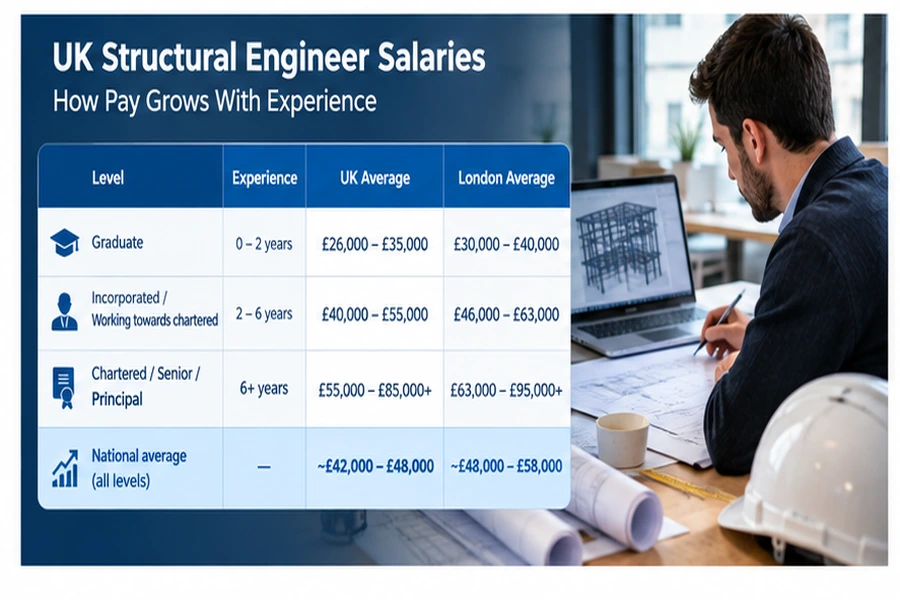
| Level | Experience | UK Average Salary | London Average |
| Graduate | 0–2 years | £26,000 – £35,000 | £30,000 – £40,000 |
| Incorporated/workingg toward chartered | 2–6 years | £40,000 – £55,000 | £46,000 – £63,000 |
| Chartered / Senior / Principal | 6+ years | £55,000 – £85,000+ | £63,000 – £95,000+ |
| National average (all levels) | — | ~£42,000 – £48,000 | ~£48,000 – £58,000 |
What I found when researching this is that salary sites disagree more here than usual, and one example is worth calling out directly. Glassdoor has two separate pages quoting almost the same London salary, around £38,200, but one says London pay is 1% above the national average and the other says it’s 72% below it. That’s clearly a broken comparison figure on their end rather than a real trend, so I’d treat any single-source “London is X% higher” claim with some caution.
Beyond that one glitch, here’s what the rest of my research found: PayScale puts the average at a low £34,087, Indeed at £46,722, and CV-Library at £42,000 to £48,000, which lines up well with Indeed. SalaryExpert sits highest, at £64,954.
Based on what I found and what I already know as per my experience as a site engineer, £42,000–£48,000, matching Indeed and CV-Library, is the most trustworthy baseline.
How does your pay build?
What you get paid gets almost climbs as you grow your career as a structural engineer, and now let’s find out how that happens through improvements in knowledge and experience.
Firstly, graduate structural engineers typically start at £26,000 to £35,000, working under supervision on calculations, drawings and site inspections while building toward professional membership.
Once you’re working more independently, at what’s often called Incorporated or pre-Chartered level, pay moves to £40,000 to £55,000. Achieving Chartered status, CEng through the Institution of Structural Engineers (IStructE) or the Institution of Civil Engineers (ICE), typically adds £5,000 to £10,000 on its own, according to CV-Library, and opens the door to senior and principal roles paying £55,000 to £85,000 or more.
At director or equity partner level in a consultancy, pay can exceed £90,000, sometimes well beyond that with profit share included.
Note :- One thing my research turned up is that chartership works a little differently here than in some other engineering roles. To become an Associate Member of IStructE, you need an accredited degree.
Full Chartered Membership generally requires an accredited Master’s, or a Bachelor’s plus a separate Master’s, on top of four to six years of structured professional development, a detailed written submission, and an interview in front of a panel of chartered engineers (Prospects; GOV.UK).
It’s a genuinely demanding process, which is part of why chartered status carries real weight in this field. Beyond chartership, what I found is that moving into high-demand sectors, infrastructure, nuclear, offshore wind or rail, tends to accelerate pay further, as does taking on commercial responsibility like project sign-off and mentoring junior staff.
Where you work, and who for, changes things too
As we discuss every time, the pay you get does not rely solely on your job title. The salary is connected with lots of other factors that you have control of, or maybe not.
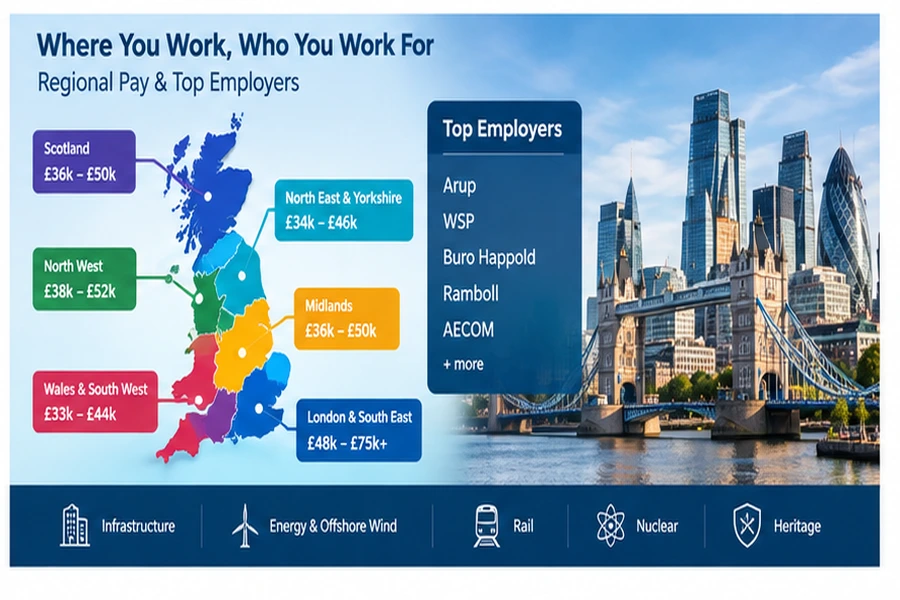
| Region | Typical Salary | Why |
| London & South East | £48,000 – £75,000+ | Major consultancies, tall buildings, HS2 |
| North West (Manchester, Liverpool) | £38,000 – £52,000 | Housing, transport growth |
| Midlands (Birmingham, Coventry) | £36,000 – £50,000 | HS2, Midlands Rail Hub |
| Scotland (Glasgow, Edinburgh, Aberdeen) | £36,000 – £50,000 | Transport upgrades, energy projects |
| Yorkshire & North East | £34,000 – £46,000 | Rail, water-related infrastructure |
| Wales & South West | £33,000 – £44,000 | Hinkley Point C, steady development work |
Structural engineering is a consultancy-led profession more than a site-based one, so who you work for matters most. Large multidisciplinary consultancies, Arup, WSP, Buro Happold, Ramboll and AECOM among them, run the biggest and most technically demanding projects and generally pay the most, especially at senior and principal level.
Smaller or specialist practices, focused on areas like heritage buildings, façade engineering or timber structures, can pay less at the base but offer a narrower, more marketable specialism over time.
If you go self-employed, I found one of the more solidly sourced freelance figures in this whole series here: Prospects puts typical contractor rates at £45 to £90 an hour. As with any contract work, weigh that against no holiday pay, no sick pay, and your IR35 status.
Career path
Most structural engineers start as a graduate engineer, working under supervision while studying toward IStructE or ICE membership. From there, you move into a role with more independence, often titled Incorporated Engineer, before reaching Chartered status a few years later.
After chartership, the path splits: some move into senior or principal engineer roles leading technical work, others move toward associate and director positions with more commercial and people responsibility, and some eventually start their own practice.
Passing your Chartered Membership exam as early as you reasonably can is the clearest way to speed this up, since so much of the pay ladder above Incorporated level assumes chartered status. Specialising in a high-demand sector, like infrastructure or offshore wind, or moving to one of the larger consultancies are the two other routes that tend to move pay fastest.
Common questions
Is structural engineering a good career in the UK?
What qualifications do I need?
Do I need to be chartered to progress?
How much more does London pay?
Structural engineer or civil engineer, what’s the difference?
How much can a self-employed structural engineer earn?
How long does chartership take?
The bottom line
Based on everything, structural engineer pay in the UK runs from around £26,000 at graduate level to £90,000 or more for directors and partners, and chartership through IStructE or ICE is the single clearest lever for moving through that range. Early on, focus on gaining broad design experience and starting your professional development record as soon as you can, since the chartership process itself takes years to complete properly.
Once chartered, specialising in a high-demand sector and choosing a larger consultancy are the two clearest routes to the top of the range. Whatever number you’re on now, check it against the region and employer type you’re actually targeting, and don’t put too much weight on any single job board’s “London premium” claim without checking a second source.