How to Get a CSCS Card in the UK (2026 Guide)
A CSCS card is proof that you have the right training and health and safety knowledge to work on a UK construction site. It isn’t actually a legal requirement, but in practice you won’t get past the gate of almost any major site without one, since virtually all principal contractors and clients treat it as a condition of site access.
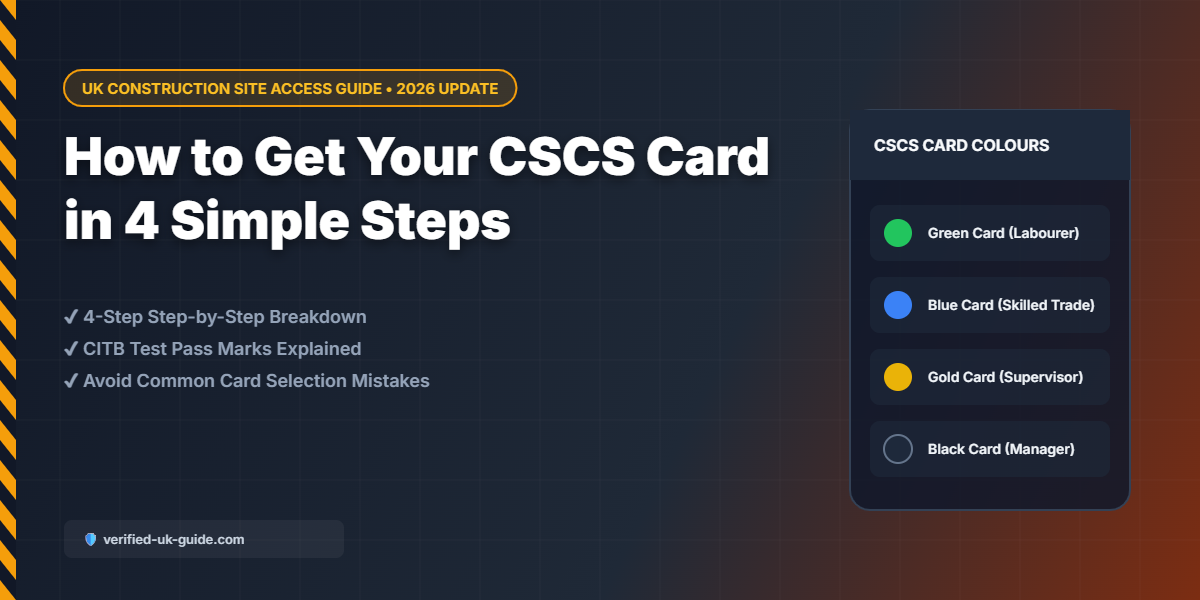
As per my research, getting one comes down to four steps, as follows.
- Work out which card matches your role
- Get the qualification behind it and pass the CITB Health, Safety and Environment test
- Then apply for the card.
The card itself is the fast part. The qualification is almost always what takes the time.
This guide is for anyone applying for their first CSCS card, tradespeople stepping up to a higher card, and employers sorting cards out for their team. So why wait, let’s get in.
Which CSCS card do you need?
| Colour | Who it’s for | Qualification needed |
| Green | Labourers and general operatives, new to construction | Level 1 Health & Safety award |
| Red | Trainees, apprentices, and experienced workers still finishing a qualification | Enrolment on an approved course or apprenticeship |
| Blue | Skilled tradespeople | NVQ or SVQ Level 2 in your trade |
| Gold | Supervisors and advanced craftspeople | NVQ or SVQ Level 3 |
| Black | Construction managers | NVQ Level 6 or 7, or an equivalent degree |
| White | Academically or professionally qualified people | Chartered status or a relevant degree, verified through your professional body |
| Yellow | Visitors who aren’t construction workers | None, but you still need to pass the relevant test |
What I found researching this is that sources don’t always agree on exactly how many official colours there are; some count six, some seven, some as many as thirteen once you include every trainee and professional variant, but the table above covers the ones you’ll actually run into day to day.
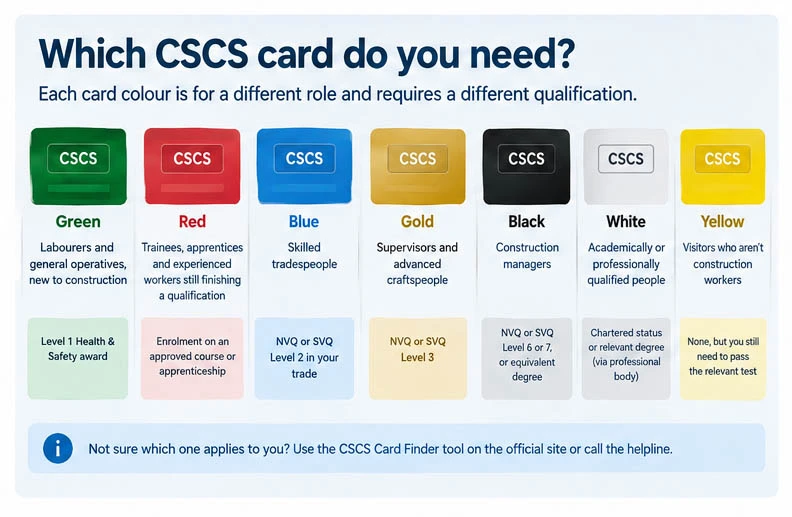
If you’re not sure which one applies to you, the CSCS Card Finder tool on the official site, or their helpline, will tell you directly rather than leaving you to guess.
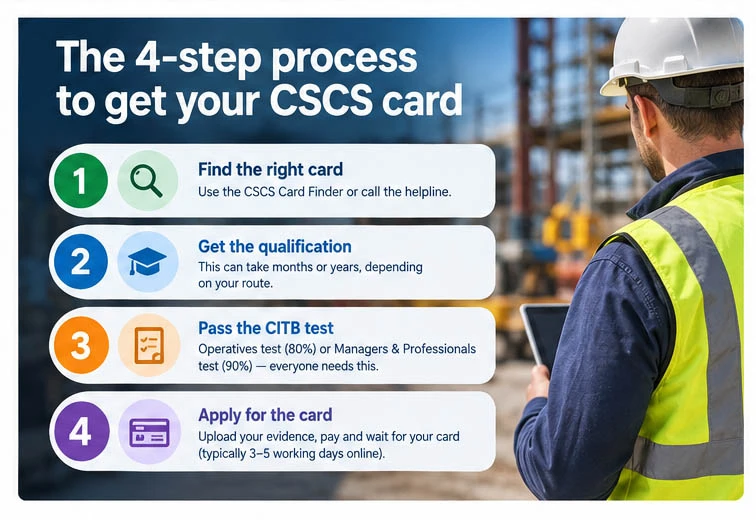
How to get the card: a four-step process explained
As I’ve mentioned at the beginning, there are 4 steps to get the CSCS card; let’s discuss those steps in detail to help you out for a smoother process.
Step 01 – Find out which card you need.
Use the CSCS Card Finder or call the helpline. Getting this step wrong is the single most common mistake, and according to what I found, some workers apply for the easier Green card even when their trade qualifies them for Blue, which can get flagged at site audits later.
So be smart when choosing the right card, and if not, you will lose your credibility, as well as the money you spent getting the wrong card.
Step 02 – Get the qualification for that card.
For Green, that’s a Level 1 Health and Safety award, and for Blue, Gold or Black, it’s the relevant NVQ or SVQ, or a degree for some professional routes.
This is genuinely the longest part of the whole process, sometimes taking months or years depending on the qualification, so it’s worth starting here rather than treating the test and application as the main event.
Step 03 – Pass the CITB Health, Safety and Environment test.
Everyone needs this, regardless of card colour, and it has to be within the last two years when you apply. Green, Blue, Gold and Red cards use the Operatives test, with a pass mark of 80%. Black and White cards use the tougher Managers and Professionals test, with a 90% pass mark.
Step 04 – Apply for the card.
Once you’ve got your qualification and a valid test pass, apply through the official CSCS system, upload your evidence, and pay. Online applications are typically processed in three to five working days; postal applications can take up to two weeks.
What does it cost, and how long does it take?
Based on what I found, the CITB test costs around £22.50 to £23.50, and the card itself costs £36, so most routes come to roughly £59 to £60 in total, though fees do change over time, so it’s worth confirming the current numbers on cscs.uk.com before you pay.
Delivery is quick once you’re through the test and qualification stage, typically a handful of working days for online applications.
Most cards, Blue, Gold, Black and White, are valid for five years. The Green Labourer card and the various Red trainee cards are meant as temporary stepping stones, so check the current validity period directly with CSCS.
These terms get updated periodically, and some sites won’t accept a Red card from someone who finished training more than 12 months ago.
Renewing your card
Start the renewal process six to eight weeks before your card expires. Renewal isn’t instant, and letting your card lapse means you could be turned away from site until it’s sorted.
If your qualification level has changed since your last card, for example, you’ve completed a Level 3 NVQ since getting your Blue card, renewal is also the point to upgrade to Gold rather than simply reissuing the same colour.
What are other important facts worth knowing?
CSCS is in the process of moving from physical plastic cards toward digital cards, so don’t be surprised if the exact application experience looks a little different by the time you apply.
And if you work in a trade like electrical or scaffolding, you may come across partner scheme cards, the JIB Gold Card or a CISRS card, for example, which work alongside or instead of a standard CSCS card on many sites, though not universally, so check what your specific site accepts.
Common questions
How can I check My CSCS card online?
To check your own card’s details specifically, occupation, qualification and expiry date, sign in to your CSCS Online account or the “my CSCS” app instead.
How long does it take to get a CSCS card?
Can I get a CSCS card with no experience?
What happens if I apply for the wrong card?
Do I need to renew my CSCS card?
What happens if my CSCS card expires?
Can I renew my CSCS card online?
The bottom line
Getting a CSCS card takes four steps: pick the right card, get the qualification for it, pass the CITB test, then apply. The qualification is the part that actually takes time, not the application, so start there. Use the Card Finder tool to get the right card colour from the start, picking the wrong one just means more delay later. And once you’ve got your card, set a reminder for six to eight weeks before it expires. Renewing takes a while, and an expired card means no site access until it’s sorted.