
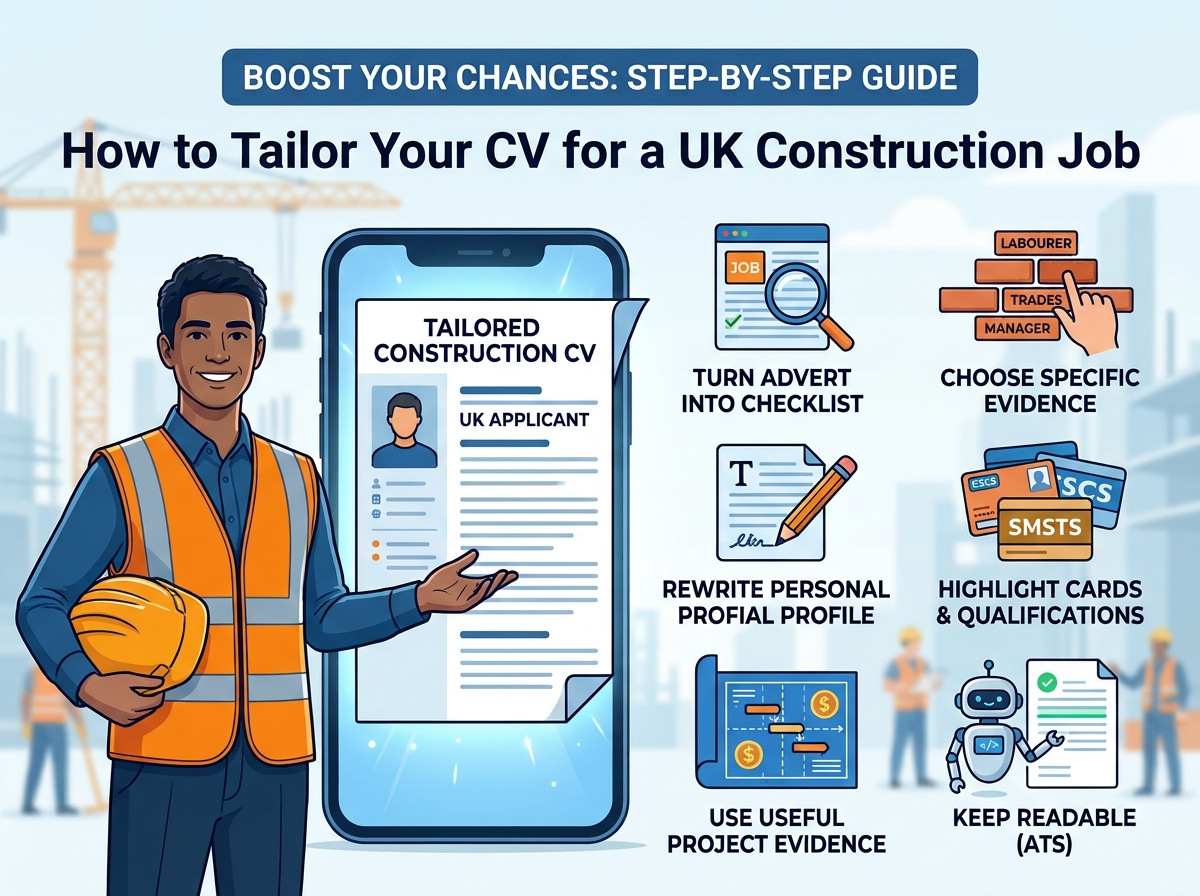
How to Tailor Your CV for a UK Construction Job
A good construction CV makes it easy to see what you can do, which projects you have worked on, and whether your qualifications match the vacancy.
But a CV that suits a housebuilding contractor may need different evidence for a civil engineering firm or fit-out specialist. Sending the same version everywhere can bury your strongest experience.
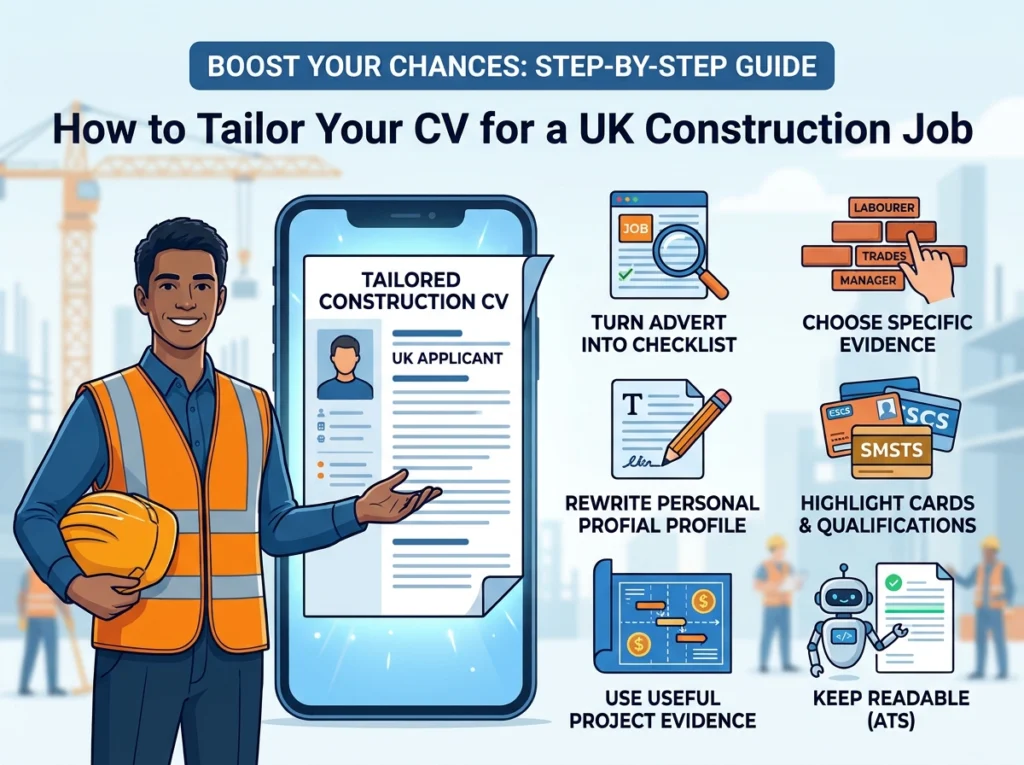
To tailor your CV for a UK construction job, identify the advert’s main requirements, match them to genuine examples, then update your profile, skills, project achievements and qualifications. Keep your career history accurate and bring the most relevant evidence forward.
So I created this guide showing you how to do that, whether you are applying as a labourer, tradesperson, engineer, surveyor or manager. So I invite you to tick around until the end to find out what you’ve been looking for.
Step-by-Step Guide to Tailoring Your CV for a UK Construction Job
Creating a CV that helps you stand out among hundreds of applicants and secure the job isn’t easy. That’s why you need the step-by-step guide below.
1. Turn the job advert into a checklist
Before editing your CV, highlight three things:
- Essential requirements: qualifications, cards, experience or licences the employer explicitly requires.
- Main duties: the work you will actually do.
- Preferred extras: useful experience, software or specialist training.
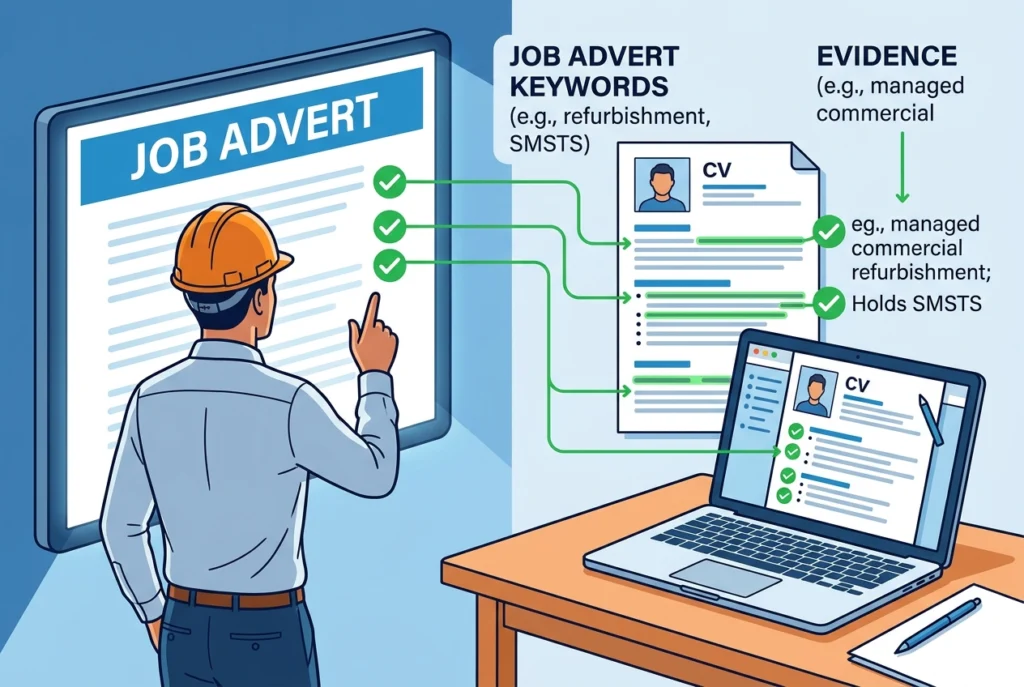
Then write one piece of evidence beside each requirement. The National Careers Service recommends tailoring your CV to the job and employer.
For example, imagine a site manager advert asks for refurbishment experience, subcontractor coordination and current SMSTS certification:
| Advert requirement | Evidence to include |
| Commercial refurbishment | Project type, scope and your responsibilities |
| Subcontractor coordination | Trades coordinated, team size and delivery example |
| Current SMSTS | Certificate name and actual expiry date |
If you cannot support a requirement, leave it as a gap. “Training booked” is different from “qualified”.
Also check the employer’s website. Experience working in occupied schools, for example, may be particularly relevant to a contractor delivering education projects.
2. Choose evidence that fits the construction role
“Construction experience” is too broad. Select the details that show you can handle this particular job.
- Labourer: preparing work areas, moving materials, supporting trades and following site instructions.
- Skilled tradesperson: your trade, relevant qualifications, installations completed, drawing interpretation and quality checks.
- Site manager or supervisor: subcontractor coordination, programme progress, inspections, safety briefings and handover.
- Quantity surveyor or estimator: measurement, tendering, procurement, valuations, cost reporting and relevant contract experience.
- Civil or site engineer: setting out, surveying equipment, drawing checks, inspections and technical records.
For commercial roles, the National Careers Service quantity surveyor profile helps explain the work behind those skills.
Be specific about software too. “Used Excel to maintain monthly cost reports” tells an employer more than “IT literate”. Name systems such as AutoCAD or CostX only when you have used them, and describe your level honestly.
3. Rewrite your personal profile
Your opening paragraph should connect your experience to the vacancy in three or four short lines.
Use this structure:
Your role + relevant experience + project specialism + strongest matching evidence.
For the refurbishment vacancy above, an illustrative profile could read:
Site manager with six years’ experience delivering commercial refurbishments, including projects in occupied buildings. Experienced in coordinating subcontractors, monitoring programme progress and managing snagging through to handover. Holds current SMSTS certification and a relevant CSCS card.
Replace every detail with your own facts. A beginner’s profile should describe training and practical experience rather than claim established site expertise.
Avoid unsupported phrases such as “exceptional professional”. Keep your official past job titles accurate; explain comparable responsibilities in the descriptions beneath them.
4. Make cards and qualifications easy to check
Create a clearly labelled “Cards, Training and Qualifications” section. Place it near the top when credentials are central to the advert.
For relevant entries, include:
- The full qualification, card or course name.
- The level, occupation or equipment category, where applicable.
- Completion date and expiry date, where applicable.
- Accurate status: completed, studying, or booked.
For example: Site Management Safety Training Scheme (SMSTS), CITB — expires [month/year].
A CSCS card is not a legal requirement, although most principal contractors and major housebuilders require workers on their sites to hold one. See the official CSCS explanation.
The card must fit your occupation. The CSCS Labourer card is for labouring roles, rather than skilled occupations.
CITB confirms that SMSTS and SSSTS certificates are valid for five years. Check your actual dates; do not describe expired credentials as current.
For professional memberships, state your actual grade. Working towards chartership is different from holding chartered status.
5. Replace vague duties with useful project evidence
List your jobs with the most recent first. Under each, include the employer, job title, location, and dates, followed by relevant bullet points.
Build stronger bullets using:
Action + project context + scope or result.
These illustrative examples show the difference:
- Weak: “Helped on building sites.”
Stronger: “Prepared materials and maintained clear access routes while supporting bricklayers on a 30-home development.” - Weak: “Managed subcontractors.”
Stronger: “Coordinated four subcontractor teams during an occupied office refurbishment, sequencing work around client access requirements.” - Weak: “Responsible for cost control.”
Stronger: “Prepared monthly cost reports for three subcontract packages and flagged forecast overspend before the next procurement stage.”
Use genuine numbers when available: project value, units completed, team size or measured savings. You do not need a percentage improvement in every bullet.
Distinguish your contribution from the whole project. Working on a £20 million scheme does not mean you personally managed its full budget.
For safety, describe actions such as reporting hazards or following site procedures. These reflect HSE guidance on construction workers’ responsibilities.
6. Keep the CV readable for online applications
An applicant tracking system, or ATS, helps employers manage applications. Some systems also extract information from uploaded CVs.
Use standard headings, a single column and ordinary bullet points. Keep contact details in the main document. Greenhouse’s parsing guidance identifies columns, complex tables, graphics and information in headers or text boxes as potential problems.
Use the advert’s terminology where it accurately describes your experience. Write “risk assessments and method statements (RAMS)” rather than relying on the abbreviation alone.
Follow the employer’s requested file format. If submitting a PDF, export a text-based document instead of a scanned image. Check any fields populated after uploading.
Avoid hidden keywords and long lists of skills you cannot demonstrate.
7. Handle limited experience, overseas work and short contracts
New to construction?
Bring relevant education, college projects, work placements and volunteering forward. Explain the task, tools used, and supervision received.
Warehouse experience can demonstrate stock handling and teamwork; it should not be presented as construction-site experience.
Worked overseas?
Include the country, project type, and your responsibilities. Give qualifications their correct titles and avoid claiming UK equivalence without verification. Where relevant, check CSCS guidance for international qualifications.
Several agency assignments?
You can group them under the agency, with dates and selected projects, while making each assignment clear. Label self-employment accurately and explain significant gaps briefly.
Add availability, travel arrangements, or a driving licence when relevant to the vacancy. If work permission needs clarification, state your position accurately; employers must check it before employment starts. See GOV.UK’s right-to-work guidance.
8. Check the UK CV basics
Aim for two A4 pages for most applications. One page may suit a beginner; extensive relevant experience may justify more. Prospects’ CV guide explains these exceptions.
Include your name, phone number, professional email and town or city. Add a relevant LinkedIn or portfolio link.
Leave out your photo, date of birth and marital status. Avoid putting passport details, National Insurance numbers or referees’ contact details on the CV.
Use consistent dates, readable text and UK spelling. Save the file with a clear name, such as “Alex-Taylor-Site-Manager-CV.pdf”.
Frequently asked questions
Should I tailor my CV for every construction job?
Can I apply without meeting every requirement?
Do I need a cover letter?
Your final construction CV checklist
I hope you have learned what you were looking for, and finally, before sending your CV, check:
- The opening matches the vacancy.
- Essential credentials and their status are clear.
- Relevant projects appear prominently.
- Bullet points explain your personal contribution.
- Claims, dates, and figures are accurate.
- Contact details and uploaded formatting work.
- The file follows the application instructions.
Start with one live advert and put your best evidence beside its three main requirements. Those matches should guide what you change first.