
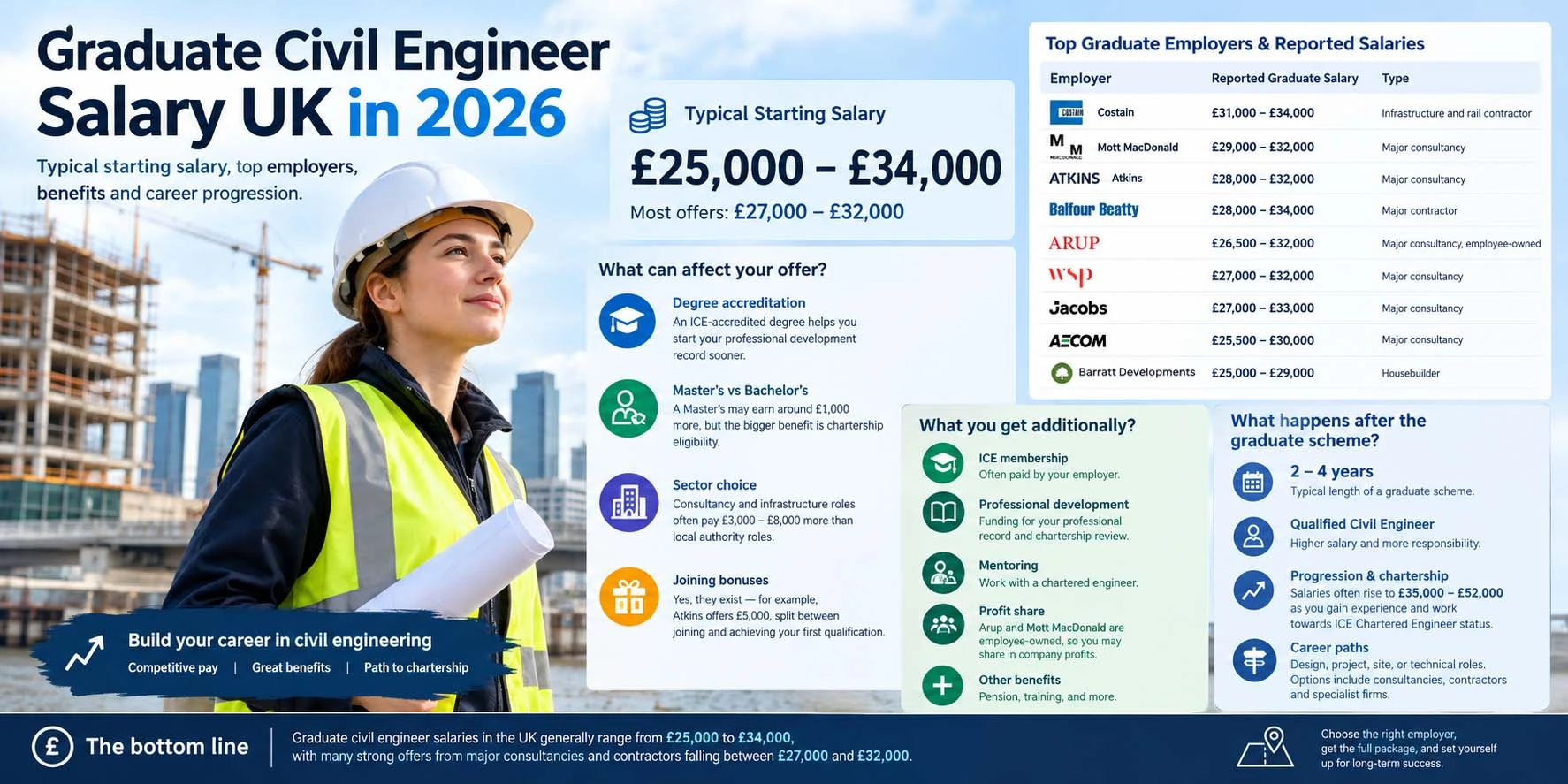
Graduate Civil Engineer Salary UK in 2026
A graduate civil engineer usually starts with a structured programme at a design consultancy or large contractor. You gain experience on different projects while working toward ICE chartership. It is the usual starting point for civil engineering graduates who want to become chartered engineers.
As per my research, pay typically runs from £25,000 to £34,000, with most solid offers landing between £27,000 and £32,000. This guide is for final-year students and recent graduates comparing offers, careers advisors, and employers checking their own graduate offer is competitive.
What do UK graduate civil engineers earn?
Save the Student’s analysis of HESA graduate outcomes data puts civil engineering starting salaries at £26,000 to £30,000, and that lines up closely with what I found elsewhere.
Graduate civil engineers in the UK usually earn between £25,000 and £32,000 a year when they start their careers. The exact salary depends on the employer, location, type of organisation, and the size of the company.
Major engineering consultancies tend to offer higher starting salaries, often around £26,000 to £31,000. Smaller and regional consultancies may offer around £24,000 to £28,000. Graduate roles in local authorities and other public sector organisations can start lower, typically around £23,000 to £27,000.
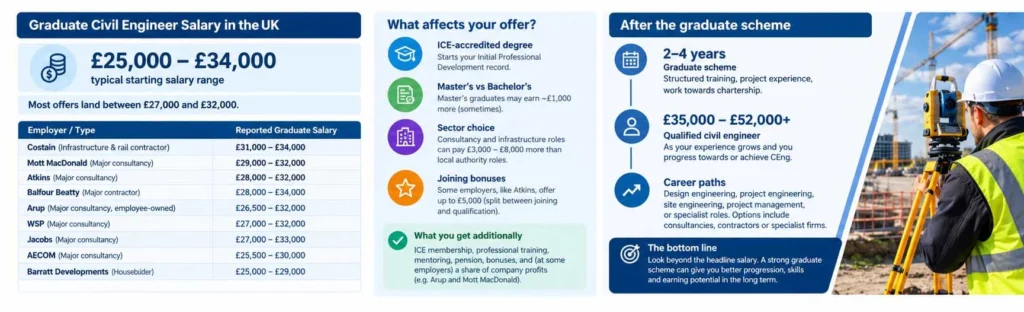
For graduates joining a large private-sector employer, a starting salary of around £27,000 to £32,000 is a reasonable expectation. Some employers may offer more, especially for roles in London, specialist engineering fields, or large infrastructure projects.
Salary is only one part of the package. Graduate programmes at larger employers may also include professional training, paid professional membership, bonuses, pension contributions, and support toward ICE chartership. These benefits can make a lower starting salary more attractive if the role provides strong career development.
| Employer | Reported Graduate Salary | Type |
| Costain | £31,000 – £34,000 | Infrastructure and rail contractor |
| Mott MacDonald | £29,000 – £32,000 | Major consultancy |
| Atkins | £28,000 – £32,000 | Major consultancy |
| BAM | £31,000 – £34,000 | Infrastructure |
| Balfour Beatty | £28,000 – £34,000 | Major contractor |
| Arup | £26,500 – £32,000 | Major consultancy, employee-owned |
| WSP | £27,000 – £32,000 | Major consultancy |
| Jacobs | £27,000 – £33,000 | Major consultancy |
| AECOM | £25,500 – £30,000 | Major consultancy |
| Barratt Developments | £25,000 – £29,000 | Housebuilder |
Consultancies and infrastructure-focused contractors sit at similar levels to each other, generally ahead of housebuilders and well ahead of local authority roles.
What actually moves your offer?
A few specific things stood out from my research. Whether your degree is ICE-accredited matters more than which university you attended, since it starts your Initial Professional Development record on the right footing.
Master’s graduates are sometimes offered slightly more than Bachelor’s graduates for the same scheme: TargetJobs cites National Grid paying £31,379 for a Master’s versus £30,278 for a Bachelor’s on its broader engineering scheme, a useful illustration even though that particular example sits outside construction specifically.
Sector choice makes a real difference too: JustEng’s figures show consultancy and infrastructure roles paying £3,000 to £8,000 more than local authority roles at graduate level.
And joining bonuses do exist, if less commonly than the headline salary suggests: Atkins offers £5,000 per graduate, split between joining and achieving your first professional qualification a few years later, which is a genuinely useful structure since it rewards you for actually progressing rather than just showing up.
What you get additionally?
Look past the headline number when comparing offers. Most decent graduate schemes at consultancies and major contractors pay your ICE membership subscription, fund the professional development record and Chartered Membership review process, and pair you with a mentor who’s already chartered.
Arup and Mott MacDonald are both employee-owned, which means graduates get a share of company profits on top of salary, something worth asking about directly since it doesn’t always show up in advertised figures. As with the graduate site engineer route, a structured, well-supported scheme is often worth more over three or four years than an extra £1,000 or £2,000 on your starting salary.
What happens after the graduate scheme?
A graduate civil engineering scheme usually lasts around two to four years. After completing it, you can move into a full Civil Engineer role with more responsibility and a higher salary.
At this stage, many engineers are also working toward ICE Chartered Engineer status. As your experience grows and you progress toward or achieve chartership, your salary can move into the £35,000 to £52,000 range. Senior and specialist roles can pay considerably more.

Your next role will depend on the career path you choose. You could progress into design engineering, project engineering, site engineering, project management, or technical roles. Some engineers stay with consultancies, while others move to major contractors or specialist firms.
If you want to understand salaries and progression beyond the graduate level, see our Civil Engineer Salary UK Guide. For a more site-focused career, our Graduate Site Engineer Salary UK Guide and Site Engineer Salary UK Guide cover that route in more detail.
Common questions
What’s a good starting salary for a graduate civil engineer?
Does my degree need to be ICE-accredited?
Is a Master’s degree worth more than a Bachelor’s for graduate pay?
Which employers pay graduate civil engineers the most?
Should I pick a consultancy or a contractor as a graduate?
The bottom line
Graduate civil engineer salaries in the UK generally range from £25,000 to £34,000, with many strong offers from major consultancies and contractors falling between £27,000 and £32,000. At this stage, the employer and graduate scheme you choose can matter more than location.
Do not focus only on the starting salary. Look at the full package, including ICE membership, professional training, mentoring, project experience, and support toward chartership. A strong graduate scheme can give you better career progression and earning potential over the next few years.
Once you complete the graduate stage and move into a qualified civil engineer role, your salary and responsibilities can increase significantly. For the next stage of your career, see our Civil Engineer Salary UK Guide, which covers salaries, experience levels, chartership, and career progression in more detail.





One Comment