
SMSTS Course Guide UK (2026)
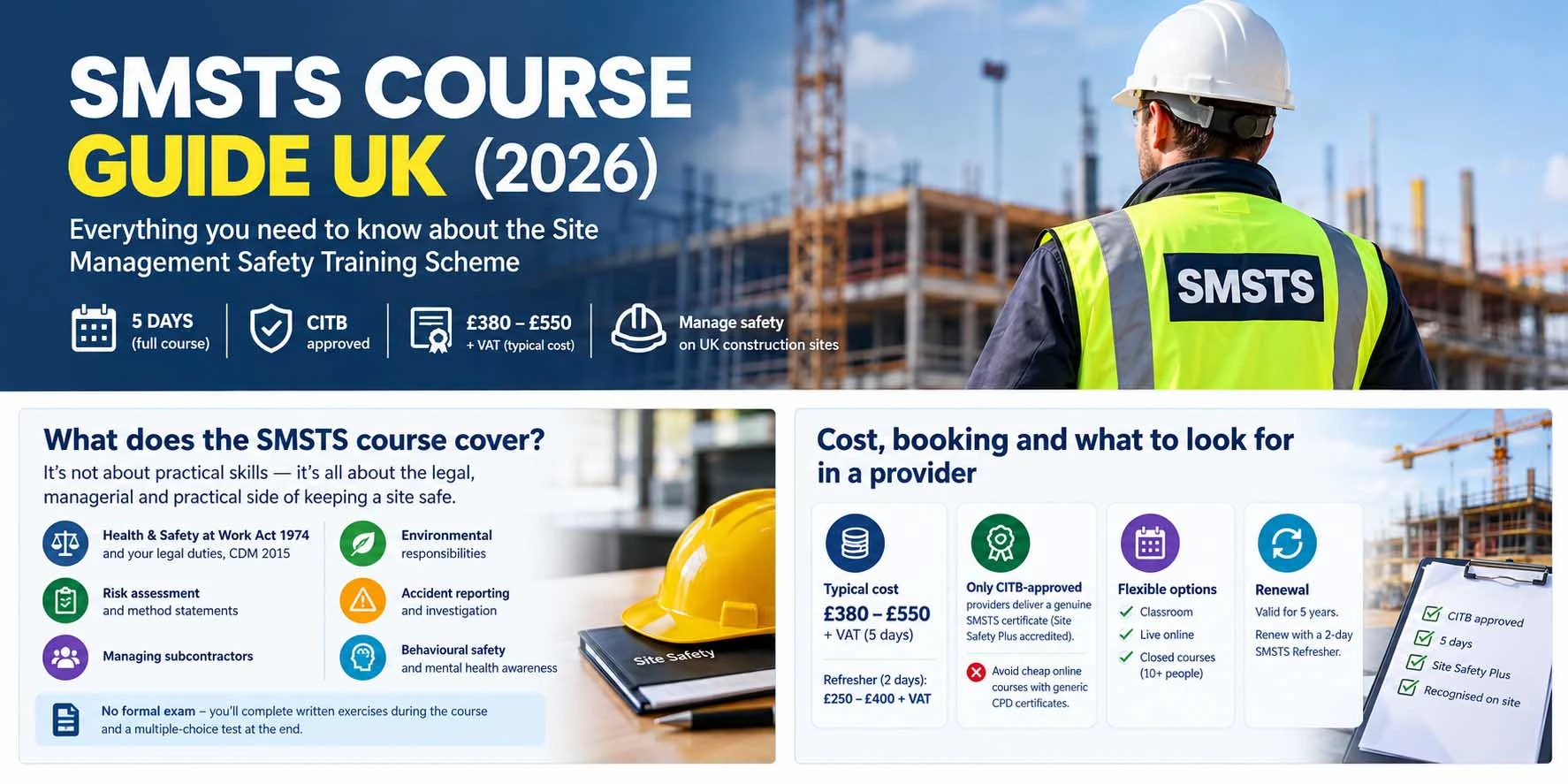
SMSTS stands for Site Management Safety Training Scheme. It’s a five-day course, run under CITB’s Site Safety Plus scheme, that qualifies you to manage health and safety on a UK construction site.
If you’re stepping into a site manager role, or already in one without the paperwork to prove it, this is the course almost every principal contractor will expect you to hold.
When doing some research, I found that one thing worth knowing before you book anything: a genuine SMSTS certificate only comes from a CITB-approved provider, runs five full days, and costs somewhere in the £380 to £550 plus VAT range.
If you see an “SMSTS” course online for £8 or £15 with a generic CPD certificate at the end, it is not the real qualification, whatever the page calls it, and sites won’t accept it. CPD accreditation and CITB accreditation are two completely different things.
SMSTS vs SSSTS: which one do you need?
| SMSTS | SSSTS | |
| Full name | Site Management Safety Training Scheme | Site Supervisors’ Safety Training Scheme |
| Length | 5 days | 2 days |
| Who it’s for | Site managers with overall site safety responsibility | Supervisors reporting to a site manager |
| Typical cost | £380 – £550 + VAT | Lower, shorter course |
| Validity | 5 years | 5 years |
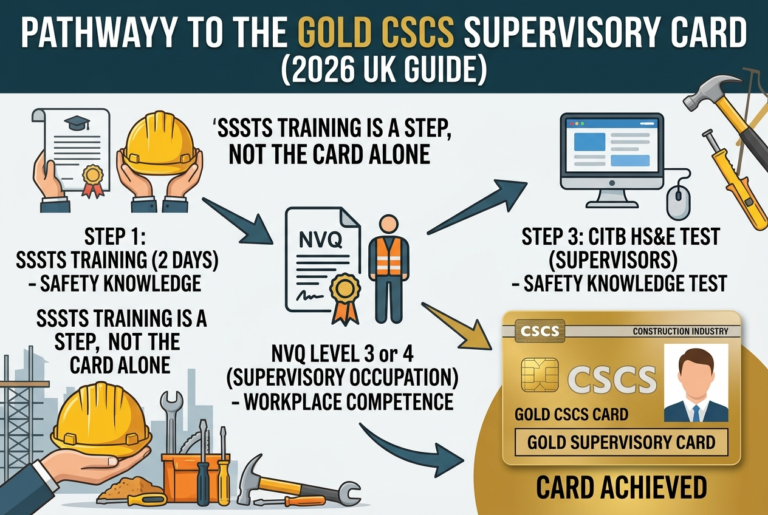
If you run the site, you need SMSTS. If you supervise a team within it and report upward to a manager, SSSTS is the appropriate one, and it’s common to do SSSTS first before stepping up to SMSTS later in your career.
What does the course actually cover?
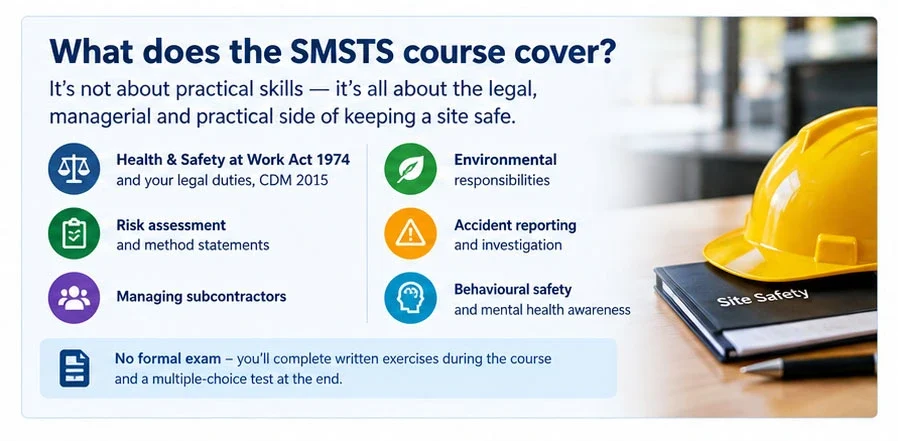
SMSTS is built around the legal and practical side of running a safe site, not physical skills training.
You’ll find modules on the,
- Health and Safety at Work Act 1974 and your legal duties, the CDM Regulations 2015,
- risk assessment and method statements,
- managing subcontractors,
- environmental responsibilities,
- accident reporting and investigation, and increasingly,
- behavioural safety and mental health awareness on site.
There’s no formal exam. You’re assessed through written exercises during the course and a multiple-choice test at the end, so a reasonable level of spoken and written English matters more than any prior qualification.
What does it cost?
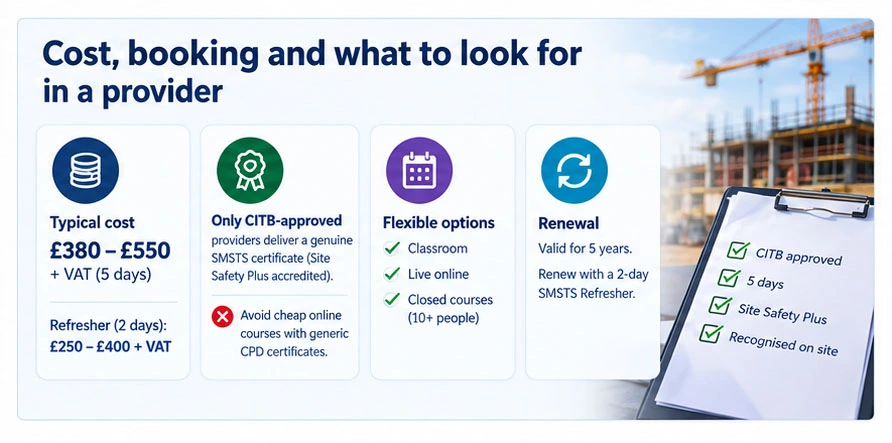
Course prices vary by provider, format and location, but a genuine CITB-approved SMSTS course typically costs £380 to £550 plus VAT for the full five days.
Some providers quote a lower headline price and then add a handbook fee and a CITB registration fee separately, sometimes another £80 to £100 combined, so it’s worth asking for the total, all-in price before you book rather than comparing headline figures alone.
The refresher course, which is two days instead of five, generally runs £250 to £400 plus VAT.
Most employers cover this cost directly, particularly for anyone stepping into or already working in a site management role, since SMSTS is often a contractual requirement on major projects.
If you’re paying for it yourself, it’s worth asking your employer to cover it or contribute before you book, since it’s very much in their interest too.
How to book, and what to look for in a provider?
Book through a CITB-approved training provider, delivering either in a classroom, in a live online format, or as a closed course at your own premises if you’re booking for a group of ten or more.
Whichever format you choose, check that the certificate you’ll receive is specifically CITB Site Safety Plus accredited, not just “CPD accredited,” since only the former is recognised on site. Course availability is generally good year-round, with new dates starting every few weeks at most providers.
Renewing your SMSTS certificate
Your certificate is valid for five years. Before it expires, you renew with a two-day SMSTS Refresher course rather than sitting the full five days again.
If your certificate has already lapsed, some providers will still let you take the shorter refresher within a grace period, but leave it too long and you’ll likely need to resit the full course from scratch, so it’s worth booking your refresher a few months ahead of the expiry date rather than waiting until the last minute.
How SMSTS fits your career?
Holding SMSTS is one of the clearest signals to an employer that you’re ready for, or already capable in, a site management role.
- It’s often a screening gate, not just a nice-to-have.
A lot of Tier 1 contractors list SMSTS as a prerequisite before they’ll even shortlist you for a Site Manager role, regardless of how much hands-on site experience you have.
No certificate often means your application doesn’t get past the first filter, no matter how strong the CV looks otherwise.
- It’s portable between employers.
Unlike an employer’s internal induction, SMSTS is a CITB-recognised qualification that travels with you.
A new employer doesn’t need to retrain you on it, which speeds up hiring decisions and makes you more mobile if you want to move between contractors for a better offer.
- It usually marks the actual moment of promotion.
Most people take SMSTS right when they’re stepping up, from Site Engineer, Senior Site Engineer, or an SSSTS-holding Supervisor role, into their first Site Manager position.
Employers frequently fund it specifically for that step-up rather than someone getting it speculatively years ahead of needing it.
- It feeds into CIOB chartership indirectly.
SMSTS itself isn’t a formal MCIOB requirement, but the practical site management responsibility it represents is exactly the kind of evidence a CIOB Professional Review panel wants to see.
It strengthens a chartership case even though it isn’t a checkbox on the application.
- It’s sometimes a contractual or insurance requirement, not just good practice.
On major projects, particularly for Tier 1 contractors and public sector clients, having a site manager with valid SMSTS can be written directly into the project’s health and safety plan or the client contract.
That’s part of why bigger employers tend to be proactive about funding your renewal, a lapsed certificate isn’t just your problem, it’s theirs too.
- It ties directly to the pay bands in the Site Manager guide.
SMSTS plus a CSCS Black card plus NVQ Level 6 are what unlock the £45,000+ mid-level range, and adding MCIOB on top is what pushes toward the £60,000–£85,000+ senior band.
Common questions
Not legally, but in practice almost every principal contractor requires it before they’ll put you in charge of a site, so treat it as essential rather than optional.
SMSTS is the five-day course for site managers with overall safety responsibility. SSSTS is the two-day course for supervisors who report to a site manager. Many people complete SSSTS first and move up to SMSTS later.
Genuine CITB-approved courses run £380 to £550 plus VAT for the full five days, with some providers charging handbook and registration fees on top. The two-day refresher typically costs £250 to £400 plus VAT.
Not a traditional one. You’re assessed through written exercises during the course and a multiple-choice test at the end, rather than a single pass-or-fail exam.
Five years, after which you renew with a two-day SMSTS Refresher course rather than repeating the full five days.
Be careful. If a course isn’t delivered by a CITB-approved provider and doesn’t lead to a genuine CITB Site Safety Plus certificate, it won’t be accepted on site, no matter what it’s called or how it’s marketed.
The bottom line
SMSTS is a five-day, CITB-approved course that qualifies you to manage safety on a UK construction site, and it’s genuinely expected rather than optional if you want to work as a site manager.
Book through a CITB-approved provider, expect to pay £380 to £550 plus VAT all in, and steer well clear of cheap “SMSTS” courses online that only carry generic CPD accreditation, since they won’t get you past the gate on a real site. Once you’ve got it, put a reminder in well ahead of the five-year mark so you can renew with the shorter refresher course instead of starting over.



2 Comments