
Graduate Site Engineer Salary UK (2026 Guide + Employer Breakdown)
A graduate site engineer role is usually a structured two-year scheme. You start on a live site under supervision, learning setting out, surveying, and site documentation while working toward your first professional qualification, EngTech or IEng, through the Institution of Civil Engineers.
It’s the standard way into site-based construction work for civil engineering, construction management, and building surveying graduates.
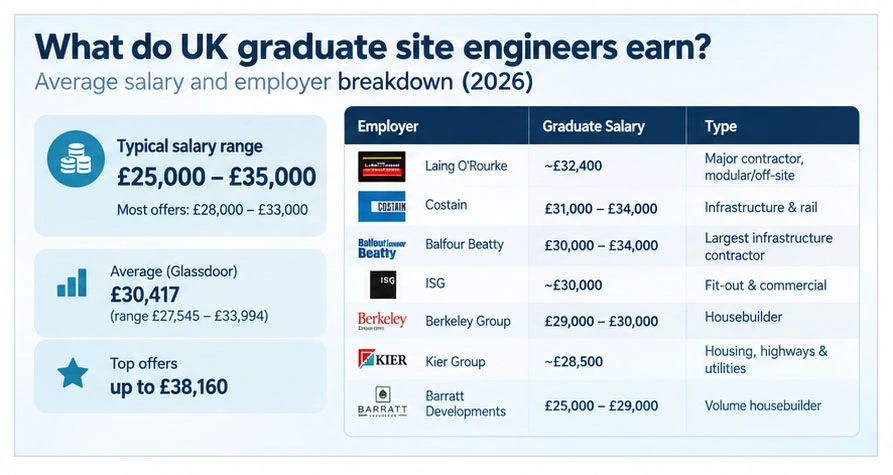
As per my research, the salary for a Graduate Site Engineer in the UK typically ranges from £25,000 to £35,000, with most graduate schemes landing between £28,000 and £33,000.
This guide is for final-year students and recent graduates comparing offers, careers advisors, and employers checking their own graduate offer is competitive.
What do UK graduate site engineers earn? Going deeper
As we mentioned earlier, it is not a single number that I can say exactly. But the following will tell you what the real average numbers are.
Glassdoor puts the average at £30,417, with a typical range of £27,545 to £33,994 and top offers reaching £38,160.
That lines up closely with what I found elsewhere: TargetJobs puts high-profile engineering graduate schemes at £25,000 to £32,000, and Save the Student’s analysis of HESA graduate data puts civil engineering starting salaries specifically at £26,000 to £30,000. £27,000 to £33,000 is a fair, honest range to work from.
Where I found real differences was between individual employers. TargetJobs’ employer-by-employer survey, last reported in 2022, so likely a little higher by now, shows a real spread:
| Employer | Reported Graduate Salary | Type |
| Laing O’Rourke | ~£32,400 | Major contractor, modular/off-site specialism |
| Costain | £31,000 – £34,000 | Infrastructure and rail specialist |
| Balfour Beatty | £30,000 – £34,000 | UK’s largest infrastructure contractor |
| ISG | ~£30,000 | Fit-out and commercial contractor |
| Berkeley Group | £29,000 – £30,000 | Housebuilder |
| Kier Group | ~£28,500 | Housing, highways and utilities |
| Barratt Developments | £25,000 – £29,000 | Volume housebuilder |
Infrastructure and rail-focused contractors, Costain and Balfour Beatty among them, tend to pay a bit more than volume housebuilders at graduate level, which matches the general pattern seen across this whole series: complex, technically demanding sectors pay a premium even at entry level.
What actually moves your offer?
A few things genuinely change what you’re offered, based on what I found researching this. An accredited degree, one recognised by the Institution of Civil Engineers, matters because it starts your chartership clock earlier, and some employers pay a small premium for it.
A placement year or industrial year out tends to add a modest bump too, since you’re arriving with real site experience rather than starting from zero.
Sector choice matters more than most graduates expect, as infrastructure and rail work generally pays more than general building or housing, for the same reason it does at every level in this series: technical complexity and scarcer skills.
And simply having more than one offer on the table gives you real room to negotiate, since graduate schemes usually have some flexibility even when the advertised number looks fixed.
What to know beyond the base salary?
The headline number isn’t the whole picture, and it’s worth looking past it. Most decent graduate schemes cover your CSCS card and study costs toward EngTech or IEng, some include a joining bonus (Multiplex, for example, has advertised a £1,500 joining bonus alongside its graduate salary), and many offer a structured two-year rotation across different project types with a formal mentor, which is worth more long-term than an extra £1,000 or £2,000 on your starting salary.
If the role involves working away from home on a site posting, check whether accommodation or a travel allowance is included, since this varies a lot between employers and can meaningfully change your actual take-home value.
Does location change your graduate offer?
Less than you’d think. Glassdoor’s data on graduate engineers in London shows pay just 1% above the national figure, a much smaller gap than you’ll see once you’re a few years into the job. Graduate schemes tend to set one national pay band regardless of where you’re posted, so don’t expect a big London premium at this stage, even if you end up working on a London site.

What happens after the graduate scheme?
Your career must not stop at just being a graduate engineer, and you must keep learning, getting experience, and going for the opportunities over time.
Once you complete your two-year scheme and move into a full Site Engineer role, pay typically moves into the £35,000 to £50,000 range, and continues climbing from there with experience and chartership.
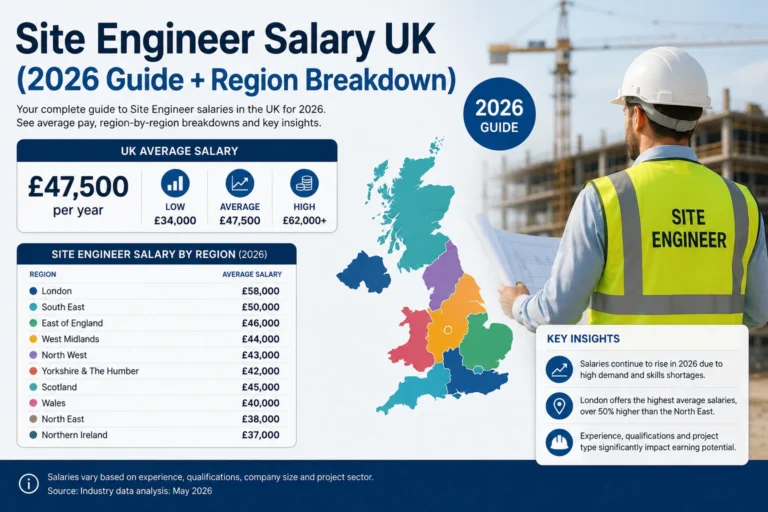
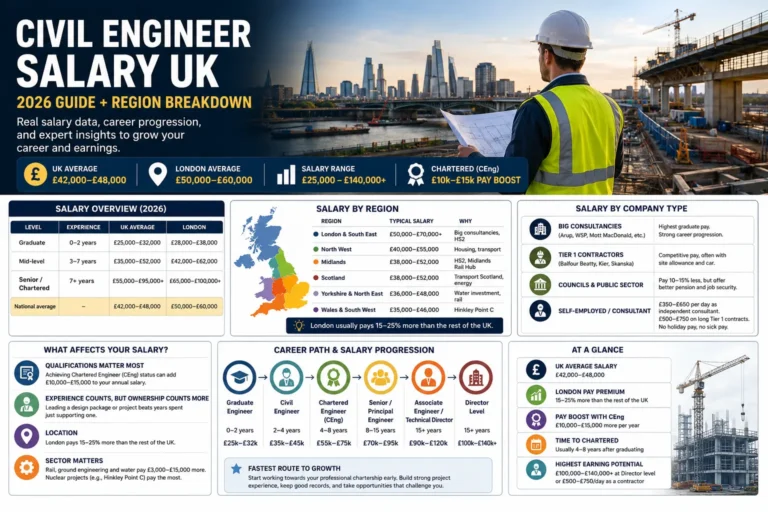
The Site Engineer Salary UK Guide covers that next stage in full, including regional and employer breakdowns. If your degree background is civil engineering rather than construction management, the Civil Engineer Salary UK Guide is also worth reading, since many graduate site engineers hold a civil engineering degree and could end up on either career path.
Common questions
Based on what I found, £28,000 to £33,000 is a solid, competitive offer in 2026. Anything above £34,000 tends to come from infrastructure specialists or major Tier 1 contractors specifically.
Less than the accreditation of your specific degree. An ICE-accredited BEng or MEng matters more to most employers than the university’s general reputation, since it starts your chartership process on the right track.
Usually, yes. It tends to add a modest bump to your starting offer and, more importantly, makes your first few months on site much less of a shock.
Based on the data I found, Costain, Balfour Beatty and Laing O’Rourke sit toward the top, largely because of their infrastructure and rail-heavy project pipelines. Volume housebuilders like Barratt tend to sit at the lower end.
The scheme matters more than most graduates assume. A well-structured programme that pays for your CSCS card, funds your chartership study, and gives you a genuine mentor is often worth more over two or three years than an extra £1,000 or £2,000 on day one.
The bottom line
FInally, graduate site engineer pay in the UK runs from around £25,000 to £35,000, with most solid offers landing between £27,000 and £33,000. The employer you choose matters more at this stage than the region you’re working in, since infrastructure and rail specialists consistently pay more than volume housebuilders for the same graduate title. Look past the headline number too: chartership support, a proper mentor, and a structured two-year rotation are worth more to your long-term pay than a marginally higher starting salary. Once you’re through the scheme, the Site Engineer Salary UK Guide picks up where this one leaves off.