
Contracts Manager Salary UK (2026 Guide + Region Breakdown)
A contracts manager oversees multiple construction projects at the same time, rather than managing just one site. They make sure each project stays on schedule, within budget, and meets safety standards. Site managers usually report to the contracts manager.
This is not an entry-level job. Most people become contracts managers after several years of experience as a senior site manager or senior quantity surveyor.
What I found was, Contracts Manager’s pay usually runs from around £45,000 for someone newer to the role, up to £100,000 or more on big projects, and a fair national average sits around £55,000 to £65,000.
This guide is for site managers or senior QSs thinking about the next step up, working contracts managers checking their pay is fair, and employers working out what to offer.
What UK contracts managers earn
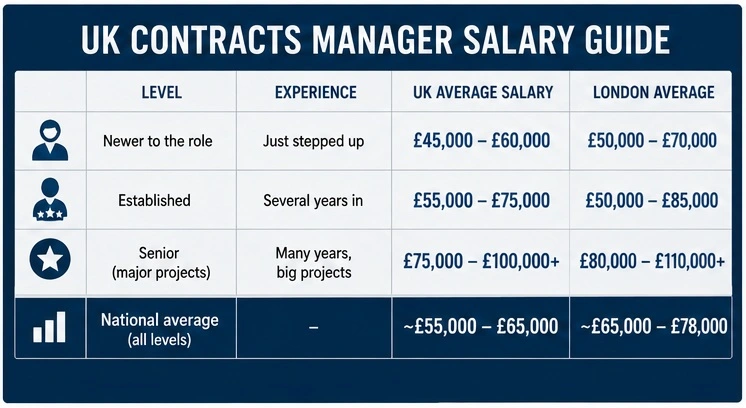
| Level | Experience | UK Average Salary | London Average |
| Newer to the role | Just stepped up | £45,000 – £60,000 | £50,000 – £70,000 |
| Established | Several years in | £55,000 – £75,000 | £60,000 – £85,000 |
| Senior (major projects) | Many years, big projects | £75,000 – £100,000+ | £80,000 – £110,000+ |
| National average (all levels) | — | ~£55,000 – £65,000 | ~£65,000 – £78,000 |
What I noticed is, the numbers vary a fair bit here, so it’s worth knowing why. Jooble shows £68,721 to £90,329, but that’s based on live job adverts, which tend to be for more senior roles. Check-a-Salary and PayScale both show around £45,000, but their samples are small and lean junior.
Morgan McKinley, a recruitment firm, puts London specifically at £45,000 to £70,000. CV-Library’s figures for the closely related “Construction Manager” title, often the same job by another name, show £55,000 to £65,000 typically, rising to £75,000 to £90,000+ for senior roles on big projects. £55,000 to £65,000 is a fair starting point.
How your pay builds?
In this job field, because contracts manager is a step up rather than a starting job, your pay when you arrive already reflects years of experience. From there, it grows mostly with the size and number of projects you’re responsible for.
As a result, someone overseeing a couple of small to medium sites earns less than someone running a portfolio of large commercial or infrastructure projects.
When it comes to qualification scenarios, chartered status through the Chartered Institute of Building, known as MCIOB, is the clearest one to have, and it strengthens your case for the top of the pay range (CV-Library).
A good understanding of UK contracts like JCT and NEC, plus skills in cost control and risk management, can increase your value to employers because these are key parts of a contracts manager’s daily job.
Where you work, and who for, changes things too
Now we knowwhat your job role is, ho you’ll get paud as a contracts manager in UK, and now let’s take look at how your salary depends, on where you work, and who you work for.
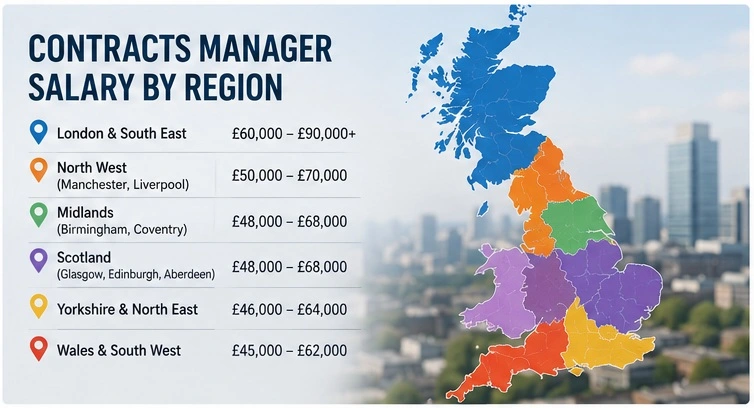
| Region | Typical Salary | Why |
| London & South East | £60,000 – £90,000+ | Major commercial and infrastructure projects |
| North West (Manchester, Liverpool) | £50,000 – £70,000 | Housing, transport growth |
| Midlands (Birmingham, Coventry) | £48,000 – £68,000 | HS2, housebuilding |
| Scotland (Glasgow, Edinburgh, Aberdeen) | £48,000 – £68,000 | Transport, energy projects |
| Yorkshire & North East | £46,000 – £64,000 | Water investment, rail |
| Wales & South West | £45,000 – £62,000 | Hinkley Point C, steady housebuilding |
In general, larger contractors pay higher salaries. Big companies like Balfour Beatty, Kier, and Skanska manage large, complex projects and often offer higher pay, along with bonuses and car allowances.
Smaller contractors and housebuilders usually pay less, but they often give you more responsibility earlier in your career. Jobs in the public sector and social housing are usually at the lower end of the pay scale.
Some contracts managers also work as freelancers or on short-term contracts. They are usually paid a daily rate instead of a salary. While exact figures are limited, experienced professionals can often earn around £450 to £700 per day, with higher rates on large or complex projects.
Keep in mind that day-rate work does not usually include paid holidays or sick leave, so it is important to understand your IR35 status before comparing it with a permanent salary.
What is Career path of a Contracts Manager in UK?
Most people become a contracts manager after working for several years as a senior site manager or a senior quantity surveyor.
After becoming a contracts manager, the next career step is often construction manager or operations manager. These roles involve managing larger projects or multiple sites across a region. Some professionals later move into director positions.
Getting MCIOB chartership while you are still a site manager or quantity surveyor can help you progress faster. Moving to a larger contractor is also a common way to increase your salary more quickly than waiting for a promotion within the same company.
Common questions
Yes, if you’re already an experienced site manager or QS. It’s a genuine step up in pay and responsibility, and it leads toward construction manager or director roles later on.
In UK construction, these titles often mean the same job, or something very close to it. Some companies use one title, some use the other.
Not to do the job, but MCIOB through the Chartered Institute of Building is the clearest way to strengthen your pay and your case for promotion.
Recruiter data puts London at roughly £45,000 to £70,000, above the £55,000 to £65,000 national average, with senior London roles going well beyond that on big projects.
There isn’t much solid data specifically for this title, but a reasonable estimate based on similar senior roles is £450 to £700 a day. Check your IR35 status before comparing this to a salary.
Get chartered through MCIOB and build a strong grip on JCT and NEC contracts while you’re still a site manager or senior QS, then look for a step-up role, ideally at a bigger contractor.
The bottom line
Contracts managers in the UK usually earn £45,000 to £100,000 or more, depending on their experience, the company, and the size of the projects they manage. It is a senior role, so people normally move into it after gaining several years of experience.
The most common path is to work as a senior site manager or senior quantity surveyor and earn MCIOB chartership along the way. Once you become a contracts manager, your salary usually increases as you manage larger or more projects. Moving to a bigger contractor is often the fastest way to increase your pay.
When comparing job offers, always consider the location and the size of the contractor, not just the average salary.