Project Manager Salary UK Construction (2026 Guide)
As per my research on this, Project managers are among the highest-paid roles in UK construction, and understanding their salary range from roughly £27,000 at graduate level to £115,000+ for senior/director roles helps inform your career choices, with a national average around £51,000–£54,000 based on multiple data sources.
I made this guide for three groups: people considering the move into construction PM from a related trade or degree, working PMs benchmarking a pay review or job move, and employers checking their offer is competitive.
Instead of quoting one number, it breaks pay down by experience, region, sector and professional qualification, so you can land on the figure that actually applies to you.
Construction Project Manager Salary Overview (2026)
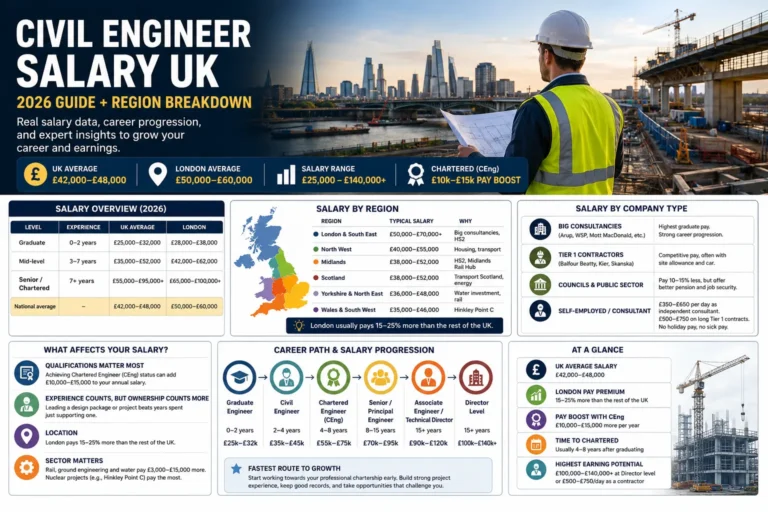
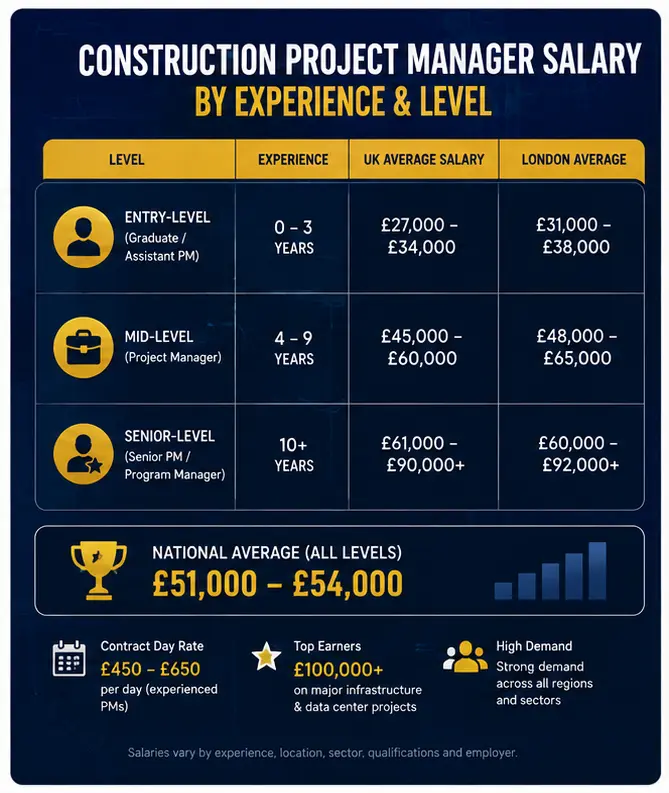
| Level | Experience | UK Average Salary | London Average |
| Entry-level (Graduate / Assistant PM) | 0–3 years | £27,000 – £34,000 | £31,000 – £38,000 |
| Mid-level (Project Manager) | 4–9 years | £45,000 – £60,000 | £48,000 – £65,000 |
| Senior-level (Senior PM / Program Manager) | 10+ years | £61,000 – £90,000+ | £60,000 – £92,000+ |
| National average (all levels) | — | ~£51,000 – £54,000 | ~£57,000 – £58,000 |
Salary sources land in a fairly tight band here, which is unusual. PayScale puts the national average at £51,486. Glassdoor has it at £52,616, with a typical range of £38,802–£72,945 and top earners reaching £100,620. Jobted puts the average slightly lower at £53,600 gross, and Indeed has the England-wide average at £54,485.
In this case, use £51,000–£54,000 as your baseline, then adjust using the breakdowns below.
Construction Project Manager Salary Breakdown
As I’ve already mentioned, not every PM in the UK gets paid the same; here are the factors affecting what you could earn,
By experience
- Graduate / Assistant PM (0–3 years): £27,000–£34,000.
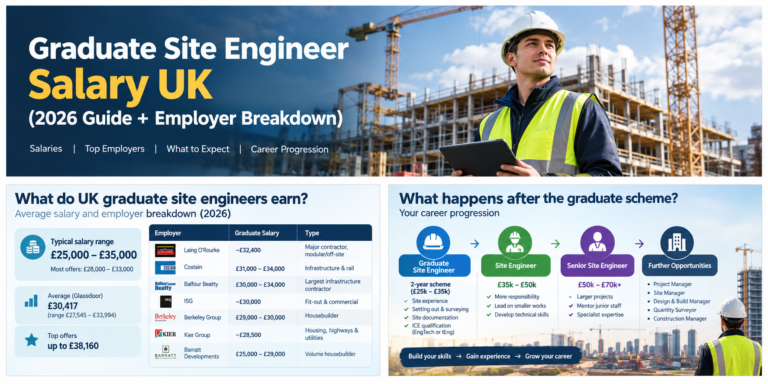
Starting pay is typically £27,000–£31,600 outside London, rising toward £34,000 in the South East according to Surveyor Success and Jobtet. Most people enter through a construction management degree, a degree apprenticeship, or a move up from site engineer or quantity surveyor after a few years on site.
- Project Manager (4–9 years): £45,000–£60,000.
As you gain experience, you take on more responsibility and start managing larger parts of projects or even small projects on your own.
At this stage, project managers earn about £49,500 a year on average, with salaries usually ranging from £45,000 to £60,000, depending on the industry and company. Earning professional qualifications like the APM PMQ or CIOB can help you move into the higher salary range.
- Senior / Program Manager (10+ years): £61,000–£90,000+.
PayScale’s senior-level data shows an average of £61,771 nationally, with Atkins Search putting London and South East senior packages at £55,000–£95,000. On major infrastructure and data center programs, total compensation regularly clears £90,000 once bonus and car allowance are added (Jobs & Travels).
Associate / Project Director: £85,000–£115,000+. Jobted puts the highest bracket at £115,000+, reserved for project directors and operations directors on major programs — a level almost always requiring chartered status (MCIOB, MRICS or ChPP) and a track record of high-value, complex delivery.
Contracting and freelance PM
Experienced construction project managers usually earn £450 to £650 per day. Those working on large infrastructure projects or senior program roles can earn even more.
Before choosing a day-rate job, remember that these roles usually do not include paid holidays or sick leave. It is also important to check your IR35 status, as it can affect how much money you take home.
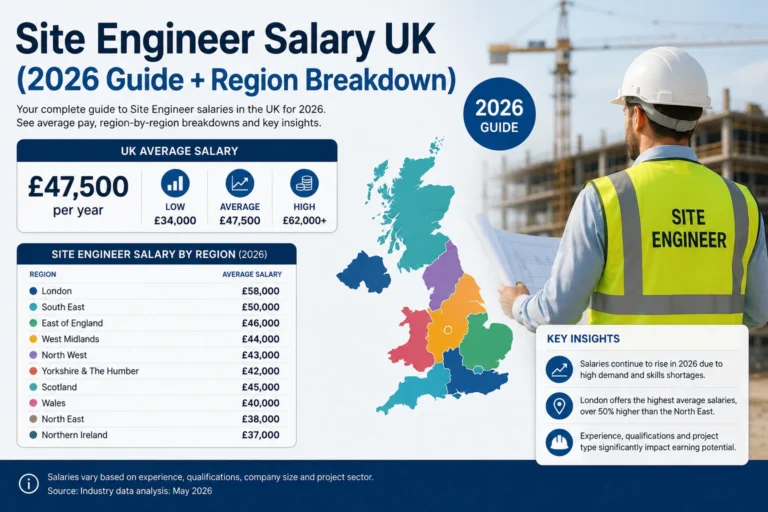
By region
| Region | Typical Salary | Why |
| London & South East | £48,000 – £92,000+ | Major consultancies, Tier 1 contractors, high project values |
| North West (Manchester, Liverpool) | £41,000 – £60,000 | Housing delivery, HS2, diverse regional economy |
| Midlands (Birmingham, Coventry) | £40,000 – £58,000 | HS2, Midlands Rail Hub, logistics/industrial builds |
| Scotland (Edinburgh, Glasgow, Aberdeen) | £48,000 – £65,000 | Transport Scotland, energy transition, financial-sector builds |
| Yorkshire & North East | £38,000 – £55,000 | AMP8 water investment, rail, public-sector frameworks |
| Wales & South West | £36,000 – £52,000 | Hinkley Point C, steady public-sector delivery |
London and the South East carry a consistent 15–25% premium over the national average (Atkins Search). However, the gap has narrowed somewhat as remote and hybrid working normalize national recruitment on some client-side and consultancy roles (PL Projects).
Manchester specifically sits roughly 15–20% below London but with substantially lower living costs, and Edinburgh pays close to the England-wide average despite Scotland’s national average sitting slightly below England’s.
By sector
- Infrastructure and rail projects (such as HS2 and Network Rail) are some of the highest-paying areas for construction project managers. There is also a shortage of skilled professionals, which is helping to increase salaries.
- Energy and data center projects are currently offering some of the best pay in the construction industry because demand for experienced project managers is very high.
- Healthcare and education projects usually pay 10% to 20% more than general residential or commercial construction jobs. This is because these projects have stricter rules and are often more complex to manage.
- Residential and general commercial: the baseline against which the sectors above are compared — still solid pay, but the smallest premium.
- Consultancy vs. contractor side: consultancy tends to offer strong bonuses, profit share, and a clearer route to Associate/Director; the contractor side often offers comparable base pay with more site-facing delivery responsibility (HD Surveyors).
Factors Affecting Construction PM Salary
Professional qualifications.
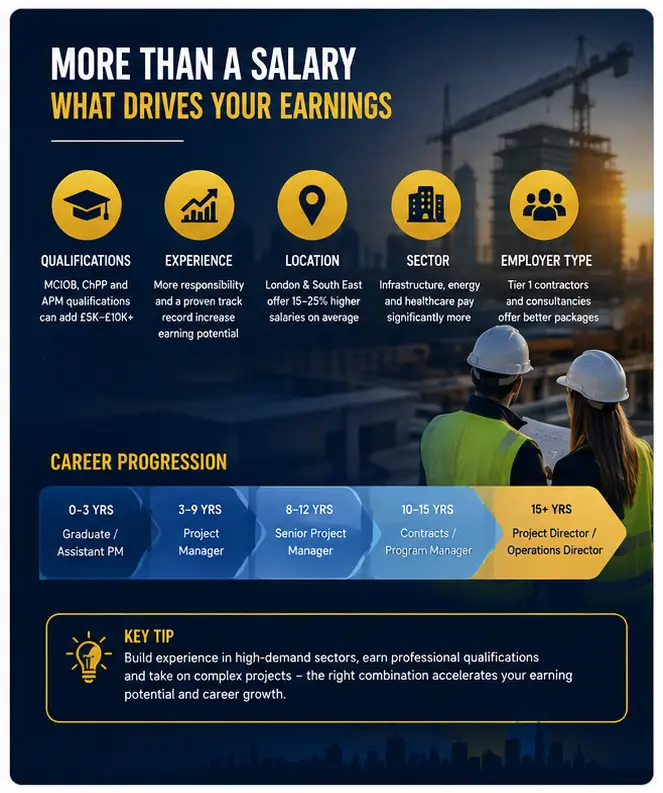
Professional qualifications like MCIOB and ChPP can boost your confidence in your skills and make you feel valued in the industry, encouraging career development.
- MCIOB is a professional qualification from the Chartered Institute of Building (CIOB). You usually need a relevant degree, a few years of construction experience, and a professional assessment to achieve it.
- Many employers look for MCIOB when recruiting for senior construction project management roles because it shows strong knowledge, skills, and industry experience.
- ChPP (Chartered Project Professional) is APM’s highest professional qualification. People with this status often earn 15% to 25% more than those without it.
- Holding professional qualifications from RICS, CIOB, or APM can boost your salary by around £5,000-£10,000 annually, making them valuable for career progression and earning potential.
Experience and track record.
The value and complexity of what you’ve delivered independently — not just years in the role — is what moves you through the mid-to-senior roles.
Location.
Covered above — London, the South East and (to a lesser extent) Scotland’s financial and energy hubs carry a consistent premium.
Sector specialization.
Infrastructure, energy and healthcare consistently outpay general residential and commercial work, and sector expertise becomes a bigger factor in pay the more senior you get.
Company type and size.
Tier 1 contractors and major consultancies typically offer higher salaries and more structured bonus schemes than smaller regional builders (CV-Library).
Career Progression
- Graduate / Assistant PM (0–3 years) — supporting a senior PM, learning contracts, procurement and site coordination
- Project Coordinator / Project Manager (3–9 years) — owning a package or smaller project outright, working toward APM PMQ or CIOB professional review
- Senior Project Manager (8–12 years) — full ownership of larger or more complex projects
- Contracts Manager / Program Manager (10–15 years) — overseeing multiple projects or a full program
- Project Director / Operations Director (15+ years) — strategic leadership across a portfolio, £85,000–£115,000+
Sector specialization — healthcare, education, data centers, rail — tends to accelerate progression faster than staying generalist, because it makes you the person clients specifically ask for (Construction Job Board). Working toward MCIOB or APM chartership alongside that specialization is the combination that most consistently unlocks Senior and Associate-level pay.
Related Salary Guides
- Quantity Surveyor Salary UK Guide — the commercial counterpart PMs work alongside on every project.
- Site Engineer Salary UK Guide — the on-site technical role many construction PMs come up through.
- Civil Engineer Salary UK Guide — the design and technical lead on infrastructure-heavy projects.
FAQs
Yes. Association for Project Management data shows construction project professionals among the higher-paid sectors for the discipline, and demand remains strong on the back of major infrastructure and energy programs.
A construction management or engineering degree is the most common route, often followed by CIOB professional review or APM’s PMQ. Degree apprenticeships and experience-based entry after several years on site are both established alternative paths.
Conclusion
Construction project manager salaries in the UK usually start at around £27,000 for graduates and can go above £115,000 for directors.
One of the best ways to increase your salary is to earn professional qualifications such as MCIOB or APM ChPP. Working in higher-paying sectors like infrastructure, energy, or healthcare can also make a big difference.
At the beginning of your career, focus on gaining experience in different types of projects and start working toward a professional qualification as soon as you can. As you gain experience, managing larger and more complex projects in high-paying sectors will usually increase your salary more than simply spending more years in the job.
Before asking for a pay rise or applying for a new role, compare your salary with others in the same sector, region, and type of employer, rather than relying on the UK average.