
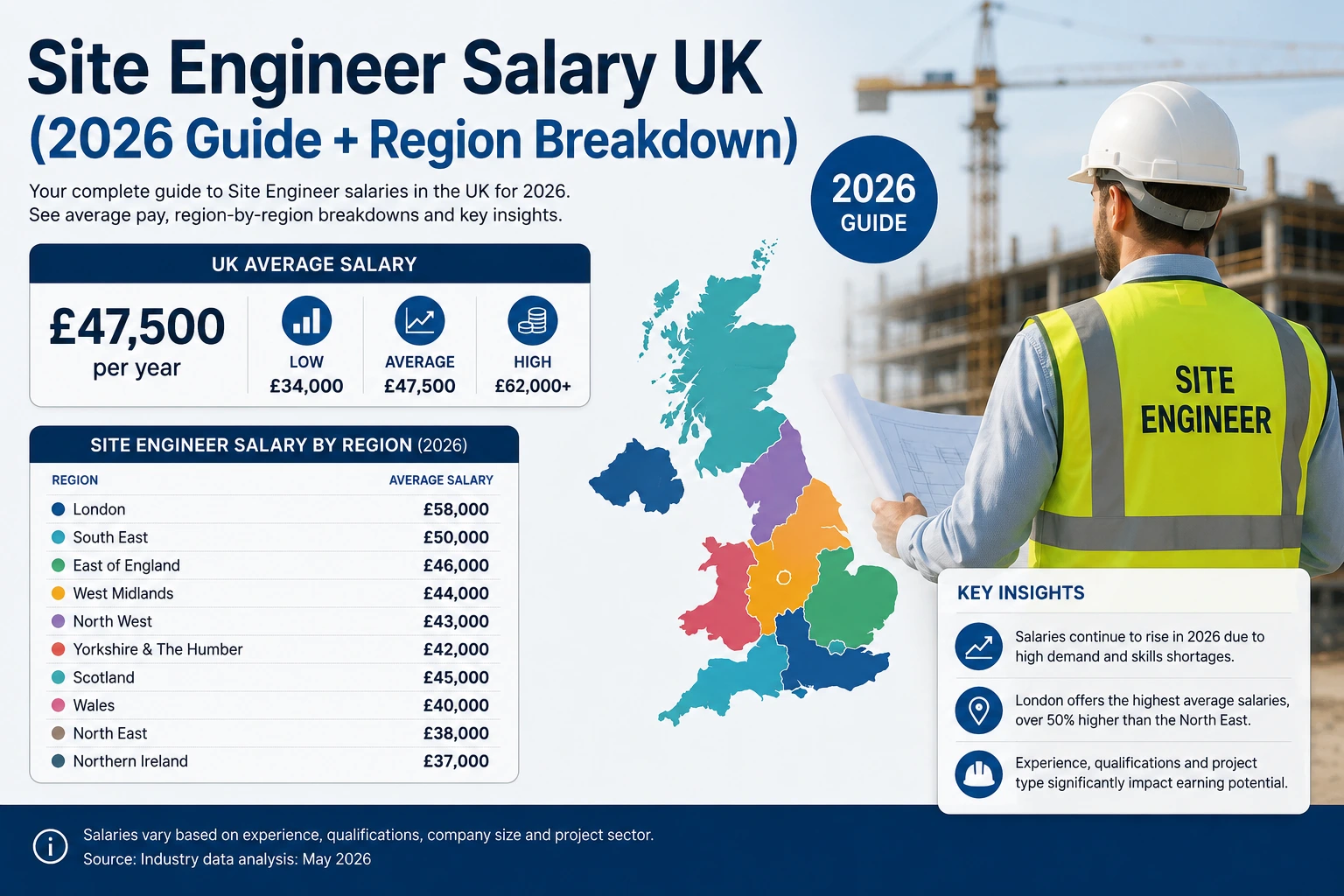
Site Engineer Salary UK (2026 Guide + Region Breakdown)
Quick answer: Before we begin, you must know that the UK site engineers earn between £28,000 and £75,000+ a year, while new starters earn around £28,000–£35,000. Most SI’s earn £35,000–£50,000 in a few years with experience, and senior engineers earn £50,000–£75,000+.
So this guide is for:
- People thinking about becoming a site engineer
- Working site engineers who want a pay rise or a new job
- Employers are checking what a fair salary looks like
We won’t just give you one number and stop there. In this guide, we break pay down by experience, location, employer type, and qualifications, so you can find the number that applies to you.
Site Engineer Salary Overview (2026)
| Level | Experience | UK Average Salary | London Average Salary |
| Entry-level (Graduate / Trainee) | 0–2 years | £28,000 – £35,000 | £30,000 – £38,000 |
| Mid-level (Site Engineer) | 2–5 years | £35,000 – £50,000 | £42,000 – £58,000 |
| Senior-level (Senior / Section Engineer) | 5+ years | £50,000 – £75,000+ | £58,000 – £85,000+ |
| National Average (All Levels) | , | ~£40,000 – £45,000 | ~£48,000 – £52,000 |
Why do salary websites show different numbers?
As we all know, it is a common question from almost all the SI’s because the salary sites really don’t agree with each other on this job title:
- Indeed, the average is about £42,300
- Randstad, using ONS government data, says about £43,150
- Glassdoor says a lower £37,500
- Reed says a much higher £62,000
Why is there a big gap? Reed’s number is based on current job adverts. This is because most companies advertise for experienced engineers, and new starters are usually hired through graduate schemes, which don’t show up in that data.
Simple rule of thumb: Use £40,000–£45,000 as your starting point, then use the following guides to find your real number.
Site Engineer Salary Breakdown
By experience
New starter (0–2 years): £28,000 – £35,000. If you have just graduated or are out of the training college, then this is what you may usually get in 2026 because you are trainee SI’s yet. So, in this range, you must focus heavily on career building rather than numbers.
Site Engineer (2–5 years): £35,000 – £50,000. This is the time to learn how to run a full or part of the project on your own, managing subcontractors and overseeing quality and safety with minimal supervision.
Senior Site Engineer (5+ years): £50,000 – £75,000+ You lead a team and take on bigger, harder projects (Prospects; Randstad). On major infrastructure projects, or if you’re chartered, this can go above £80,000.
Contractor / freelance site engineers – When it comes to freelance or contract-based engineering work, the salary is usually paid per day or per project. So this is also a good opportunity for you to focus on your most talented and experienced projects and earn a higher salary. (Carrington West):
- Normal civils and building work: £350 – £450 a day
- Hard or nuclear-licensed projects: £450 – £500+ a day
Keep in mind that contract work pays more per day, but you don’t get holiday pay, sick pay, or job security. UK tax rules, known as IR35, also affect how much of that money you actually keep. Work out the real numbers before switching to contracting.
By region
Where you work changes your pay a lot. It’s not just about city living costs; it’s about where the big, complex projects actually are.
| Region | Typical Salary | Why |
| London & South East | £45,000 – £65,000+ | Big transport and tall-building projects |
| North West (Manchester, Liverpool) | £38,000 – £52,000 | Lots of new housing, offices, and transport work |
| Midlands (Birmingham, Coventry) | £36,000 – £50,000 | HS2 and the Midlands Rail Hub |
| Scotland (Glasgow, Edinburgh, Aberdeen) | £36,000 – £50,000 | Transport upgrades and green energy projects |
| Yorkshire & North East | £35,000 – £48,000 | Water and utilities projects, rail work |
| Wales & South West | £34,000 – £46,000 | Energy projects and steady public-sector work |
A note on the London salary ranges: some salary websites even show London paying less than the rest of the UK; that’s usually a data problem, not a real trend. Recruiters and industry experts (Randstad; Lanes Group) generally agree London and the South East pay 10–20% more than the rest of the UK, and the gap grows at senior level once you add car allowances and bonuses.
What Affects Your Salary?
Obtaining key certifications such as CSCS, SMSTS, or chartered status can boost your confidence, demonstrate your commitment, and increase your earning potential.
- CSCS card
You need this to get onto most UK building sites, and the color indicates your skill level: Blue is a skilled worker, Gold is a supervisor, and Black is a manager.
- SMSTS
SMSTS: a safety course for people moving into management. Not needed for a standard Site Engineer job, but very helpful if you want to become a Site Manager.
- Chartered status
To understand salary growth, ask: How much can obtaining certifications like CSCS, SMSTS, or becoming chartered add to your pay? Chartered engineers earn noticeably more over time?
What is your experience level?
This is not all about the number of years you worked; it is more about the kinds of projects you worked on, your scope of work, and the complexity of the projects, etc.
So, in this case, two engineers with five years’ experience can be £15,000 apart if one has only worked on small housing jobs and the other has run packages on a major infrastructure scheme.
What is Your Location?
covered above, but the short version is: bigger cities and bigger projects usually mean better pay.
What is the Project type?
Readers might ask: How do different project types, such as infrastructure or residential, influence my salary, and which sectors offer the best pay for site engineers?
Career Progression
A typical site engineer career path looks like this:
- Graduate / Trainee Site Engineer (0–2 years), learning the basics: setting out, surveying, site paperwork
- Site Engineer (2–5 years) running your own section of a project
- Senior / Section Engineer or Site Agent (5–8 years), leading bigger, more complex packages and junior engineers
- Site Manager or Project Manager (8–12 years), running the whole site, including budget and people
- Contracts Manager / Construction Manager (12+ years) overseeing several projects at once
- Operations Manager / Director, running a whole business area
Two things that speed this up:
- Get your SMSTS and relevant NVQ level early; don’t wait until you’re pushed toward management.
- Start working toward chartered status alongside your day job, not after you’ve hit a plateau.
Changing employers every few years often brings a bigger pay jump than waiting for an internal promotion, especially early on.
FAQs
Well, most people who like technical, hands-on work, yes. It’s well paid, offers good opportunities for promotion, and is in high demand at the moment, with schemes such as HS2 and water network improvements. It is suitable for those unafraid to work out in inclement weather.
Employers expect most applicants to have a degree or an HNC/HND (a lower-level qualification) in civil engineering or construction, and will also require a CSCS card. It’s also possible to join an Apprenticeship programme without a higher education, although this typically takes longer to advance.
No, not always. There are alternatives, such as apprenticeships. However, there will be graduate schemes that will provide better early progression prospects for a degree.
In excess of 10–20% higher than the average for the UK, and even higher at a senior level. It may not actually be quite this low, depending on the size of the sample – some salary websites provide individual figures which can make the London figure appear low due to the small sample sizes.
Conclusion
UK site engineers earn between £28,000 and £75,000+ a year. Where you land in that range depends mostly on your region, your employer, and your qualifications, not just on how many years you’ve worked.
Just starting? Get your CSCS card and relevant NVQ level early, and try to get onto infrastructure, rail, or water projects, where the pay premium is most reliable.
More experienced? Working toward chartered status through ICE or CIOB is the change most likely to raise your long-term pay ceiling. Don’t be afraid to change employers for a bigger jump, either.
Whatever stage you’re at, check your pay against the region and company types you’re actually targeting, not just a single national average, before your next pay conversation.





3 Comments